In this guide
A scrap yard lives on the gap between the rate at which it buys and the rate at which it sells, and that gap is only a few rupees per kilo. A weighing error, a stale rate or a lot that goes missing between bays can erase a day's margin without anyone noticing. Good scrap yard software keeps four things honest: the weight, the rate, the stock and the paperwork.
Why is a scrap yard harder to run than it looks?
From outside, a yard looks simple: buy material, sort it, sell it. Inside, almost everything moves. Rates for iron, copper, aluminium, paper and plastic change during the day. Suppliers range from a household with a bag of newspapers to a factory with a truck of turnings. Material arrives mixed, damp or dirty, and what you pay for is what is left after deductions.
Most yards run on a combination of a weighbridge slip, a notebook for rates, a WhatsApp group for pickups and an accountant who reconciles at month end. That works until volume grows. Then the typical problems show up:
- The rate written on the board and the rate paid at the weighbridge differ by a rupee, and nobody can say who changed it.
- A weighment is entered twice, or not at all, because the slip was handed over and not copied.
- Stock on paper does not match stock in the yard, and the difference is called "shrinkage" without anyone checking.
- Pickup agents carry cash and a portable scale, and the evening reconciliation takes an hour of arguing.
How does a weighbridge slip become a trustworthy record?
A weighbridge measures the loaded vehicle (gross weight) when it arrives and the empty vehicle (tare weight) after it unloads. The difference is the net weight of material. Everything else, the payment, the stock entry and the audit trail, hangs on that figure, so it needs one entry, made once, at the scale.
Then come deductions. Material is rarely clean: wet paper weighs more, mixed metal carries dirt, and turnings may be oily. Yards usually agree a deduction for moisture or impurity before paying. Here is a sample weighment with made-up numbers, only to show the arithmetic:
| Step | Sample value | Note |
|---|---|---|
| Gross weight | 14,850 kg | Loaded vehicle on the scale |
| Tare weight | 6,350 kg | Same vehicle after unloading |
| Net weight | 8,500 kg | Gross minus tare |
| Impurity deduction (2%) | 170 kg | Agreed with the supplier |
| Moisture deduction (1%) | 85 kg | Agreed with the supplier |
| Payable weight | 8,245 kg | Net minus deductions |
| Rate (illustrative) | ₹28 per kg | Not a market rate |
| Amount payable | ₹2,30,860 | 8,245 kg x ₹28 |
When software does this calculation, two things improve. The deduction is visible on the slip, so the supplier sees exactly what was taken. And the rate used is the rate on the board at that moment, not the one someone remembers.
Tip
Ask whoever runs your scale to record the gross and tare from the indicator, not to type a net figure. A typed net weight cannot be checked later. Two captured readings can.
What should a live rate board actually do?
A rate board lists the buying rate and the selling rate for every material you handle. Its real job is to show the spread: the difference between what you pay and what you can sell for. A spread that is thick on copper and thin on mixed plastic tells you where to push volume and where to be careful.
Three behaviours matter. First, one place to change a rate, so the weighbridge, the pickup agents and the accounts all use the same number. Second, a clear signal when a rate moves, so the person at the scale does not pay yesterday's price. Third, a history, so you can answer "what were we paying for aluminium last Tuesday?" when a supplier complains.
Sample spread, with made-up rates: if you buy a grade at ₹28 and sell at ₹31, the spread is ₹3 per kg. On 8,245 kg that is about ₹24,700 before handling, transport and shrinkage. If the buying rate creeps to ₹30 because it was not updated when the market fell, the spread halves to ₹1 and you only learn that at month end.
How do bays, stock and pickup runs fit together?
Yard bays: know what is where
Material goes into bays, bales and heaps. A top-down plan of the yard, with bays drawn in proportion to what they hold, answers "where is the copper?" and "which bay is nearly full?" without a walk. Moving a lot from one bay to another should be one action, recorded, not a verbal instruction.
Stock and shrinkage
Stock in a scrap yard is not a clean count. Material loses weight as moisture dries out, and some of it is lost to handling or theft. A simple check keeps this honest: compare what you bought against what you sold plus what you hold. Say you bought 40,000 kg of a grade and sold 38,900 kg with nothing left in the bay. The 1,100 kg gap is 2.75 percent. Is that normal drying, a sorting loss, or something leaving through the gate? You can only ask if the number is visible.
Pickup runs
Many yards send agents to collect from households, shops and small factories. An agent weighs on a portable scale at the door, pays cash, and returns in the evening. The weak point is the evening: cash, weights and rates reconciled from memory. A pickup run record should capture each stop, the weight, the rate applied and the cash paid, so the day closes against figures and not against trust.
What about suppliers, KYC and the EPR trail?
Recyclers deal with regulated material, such as e-waste, batteries and certain plastics, and with suppliers who may need identity checks. We will not summarise the rules here, because they change and vary by material and state: check the current rules with your authority or consultant. What software can do is keep the records in order so you can answer questions when they are asked.
- Supplier KYC: a status per supplier (verified or pending), so unverified parties are visible before you pay them.
- Certificates: a trail from collected weighments to the certificate for a material category, so you can show what you processed.
- Manifests: movement documents for regulated material, tracked from generated to in transit to received.
- Authorisations and returns: expiry dates and due dates in one list, so nothing lapses quietly.
The principle is the same as in the rest of the yard: record once, at the moment it happens, and let every report read from that record.
Notebook, spreadsheet or yard software?
| Approach | Works when | Falls short when |
|---|---|---|
| Notebook and weighbridge slips | One weighbridge, few suppliers, owner on site | You cannot audit a slip later, rates vary by person, no stock view |
| Spreadsheet | Daily summaries and basic profit tracking | Live rates, bay view and pickup reconciliation are awkward and error-prone |
| Purpose-built yard software | Several materials, several agents, compliance paperwork | Needs setup and a vendor who understands weighbridge and rate logic |
How to bring scrap yard software into your yard
- Start with the weighbridge. Capture gross, tare, deductions and payment for every vehicle. Everything else depends on it.
- Put your rate list in one place. Retire the notebook and the WhatsApp rate messages once the board is live.
- Draw your bays. Match the plan on screen to what you see when you walk the yard.
- Move pickup agents onto it. Give each agent a run sheet and close the day against it.
- Add supplier KYC and the compliance trail. By then the weighments already exist to link against.
- Review spread and shrinkage weekly. The reports earn their keep only if someone reads them.
Questions to ask any vendor
- Can I apply moisture and impurity deductions and show them on the slip?
- Is there one rate source for the scale, the pickup agents and the accounts?
- Does the system keep a rate history?
- Can I see stock by bay and by lot, and move a lot between bays?
- Does it support cash and UPI payment at the scale?
- Can a pickup agent work from a phone?
- What happens to my data if I leave?
Mistakes to avoid
- Typing net weight. Capture the readings; calculate the net.
- Too many material categories on day one. Start with your top ten materials and add the long tail later.
- Treating shrinkage as a fact of life. Track it, then decide what is normal.
What the ScrapOcta demo shows
We built ScrapOcta as an interactive demo for kabadi and scrap yards, and for metal and paper recyclers. It is part of our demo apps collection. The modules it contains:
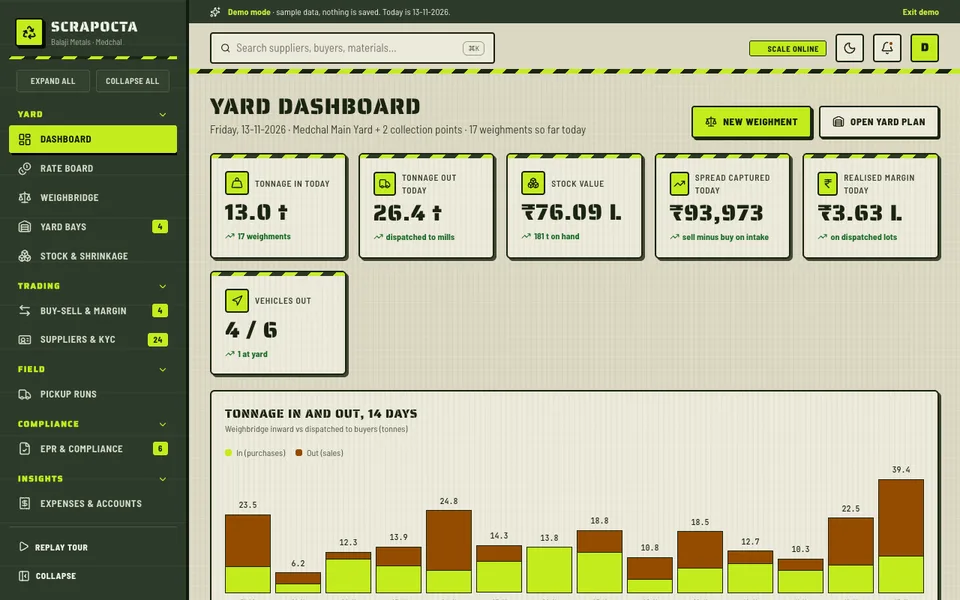
- Dashboard: tonnage in and out, stock value, spread captured today and vehicles out.
- Rate board: buy and sell rates per kg that tick live with green and red flashes, and a spread column.
- Weighbridge: a simulated live scale that captures gross and tare, applies moisture and impurity deductions, takes cash or UPI and prints the slip.
- Yard bays: a top-down plan with bays drawn in proportion to stock, click for lots, drag a lot to another bay or use the Move select on touch.
- Stock and shrinkage, buy-sell and margin: what you hold and what you earn.
- Suppliers and KYC, pickup runs: who you buy from and how agents collect.
- EPR and compliance: certificates, manifests, authorisations and returns.
- Expenses and accounts, reports, team, settings: the back-office layer.
- Yard Studio: a scrap grade identifier, fair-rate predictor, margin optimiser, weight-fraud detector, route optimiser, EPR assistant and voice entry. All of it is simulated.
To be clear about what you are looking at: the demo uses sample data for a fictional yard, nothing you enter is saved, everything resets when you refresh the page, and the Yard Studio tools are scripted simulations, not real models. It runs in the browser on desktop, tablet and phone layouts.
How to try it
Open the demo and press Try Demo Account on the login screen. Go to the Weighbridge and capture a weighment, then watch the Rate board to see the spread move, and open Yard bays to drag a lot between bays.
Getting yard software built for your business
A real yard has its own materials, its own deduction rules and its own paperwork. If you want software shaped around yours, contact Zenocta about a custom build. We will review your weighbridge setup, rate process and compliance records, then send a scoped, fixed-price proposal. We are a Hyderabad software studio with 11 people and 30+ apps, and you can browse our production apps to see how we build. For wider reading, see how MSMEs reduce costs through digital transformation and why every MSME should invest in custom software.
Try it live
Open the real thing: demos run in a new tab with sample data, apps link to their own page.
 Live demoScrapOcta live demoCapture a simulated weighment, watch the rate board tick and drag lots between yard bays, all on sample data.
- ABrowse allAll demo appsInteractive demos for dozens of industries, no sign-up needed.
- ZBrowse allZenocta appsProduction apps live on Google Play.
- TBrowse allTalk about a custom buildDescribe your yard and get a scoped, fixed-price proposal.
Frequently asked questions
01What does scrap yard software do?
It records weighbridge entries with gross, tare and deductions, keeps one live rate board, tracks stock by bay and lot, reconciles pickup runs and keeps supplier and compliance records together. The aim is accurate weights, rates and margins.
02How do moisture and impurity deductions work?
Net weight is gross minus tare. A percentage is then deducted for moisture or impurities, agreed with the supplier, to reach the payable weight. Software applies the agreed percentages and prints them on the slip so the calculation is transparent.
03Can software help with EPR and compliance records?
It can keep certificates, manifests, authorisations and return due dates in one place, linked to your weighments. It cannot tell you the rules, so check the current requirements with your authority or consultant.
04Is ScrapOcta a product I can buy?
No. ScrapOcta is an interactive demo with sample data for a fictional yard. Nothing is saved, data resets on refresh and the Yard Studio tools are simulated. It shows what Zenocta can build for a scrap business.
05How do I get yard software built for my business?
Contact Zenocta with details of your weighbridge, materials and paperwork. We review them and respond with a scoped, fixed-price proposal for a custom build shaped around your yard.