In this guide
A petrol pump sells a product that disappears into a vehicle and sits underground the rest of the time, so the only proof of where it went is paperwork. If the nozzle meters, the tank dips, the cash drawer and the fleet ledger do not agree at the end of a shift, someone has to find out why. Petrol pump management software is built around making those four records agree, shift by shift.
What a dealer reconciles every day
A typical outlet has several nozzles, a handful of underground tanks, two or three shifts, and a mix of buyers: walk-in customers paying by cash, card or UPI, and regular fleets buying on credit. Four records have to line up.
- Nozzle meters: the cumulative reading on each nozzle, taken at the start and end of a shift. The difference is litres sold.
- Tank stock: the dip reading, converted to litres, plus receipts from tankers, minus sales.
- Money: cash counted, card slips, UPI settled, and credit sales entered against fleets.
- Credit: what each fleet owes, against its limit.
When these sit in registers and a spreadsheet kept by the accountant, the reconciliation happens days later, if at all. By then nobody remembers the tanker that arrived late, the nozzle that stuck, or the fleet driver who filled twice.
Shift reconciliation, step by step with made-up numbers
Take one petrol tank on one day. These figures are illustrative.
| Item | Working | Litres |
|---|---|---|
| Opening stock (morning dip) | From the dip and calibration chart | 8,000 |
| Receipt from tanker | From the delivery documents | +12,000 |
| Sales through the nozzles | Sum of (closing minus opening) on this tank's nozzles | -14,300 |
| Expected closing stock (book) | 8,000 + 12,000 - 14,300 | 5,700 |
| Actual closing stock (evening dip) | Measured | 5,672 |
| Variance | 5,672 - 5,700 | -28 L |
A variance of 28 litres on 14,300 litres sold is about 0.2 percent. Is that acceptable? That depends on your tank, your oil company's guidance and the rules that apply to you, so check the current rules and set a tolerance you can defend. What matters more than any one figure is the trend. A tank that shows a small negative variance every day for twelve days is telling you something that a single day never would.
Tip
Plot variance per tank per day on one chart. Evaporation and reading error scatter around zero, while a leak or a faulty meter drifts in one direction. The pattern, not any single day, is what separates a bad dip from a bad tank.
Reading the variance: likely causes
When a tank is consistently short, work through the usual suspects before assuming the worst:
- Dip reading error: a stick read slightly differently by different people, or taken before the fuel settled after a delivery.
- Temperature and evaporation: small, natural differences between measured and billed volumes.
- Test measures not recorded: fuel drawn for a quality or measure test and returned to the tank, but not entered.
- Meter drift or calibration: a nozzle that delivers slightly more or less than it displays.
- A genuine leak: in a tank, a pipe or a fitting, usually a steady one-way loss.
- Wrong tank mapping: a nozzle linked in the records to the wrong tank.
A system that keeps a dip, a meter reading and a receipt for each shift can show you which cause fits, because it can ask the right questions: did the variance start after a particular tanker, or after a nozzle was serviced?
Tank dips and receipts: where accuracy begins
The dip is only as good as its conversion. A dipstick shows a depth, and a calibration chart for that specific tank turns it into litres. Store the chart in the system so nobody does the conversion in their head. At delivery, record the dip before and after, the quantity on the delivery document and the time, so a short delivery is caught on the spot, not a week later.
Fleet credit: a lending business inside the pump
Credit fleets, such as transport operators, bus services and company vehicles, can be your most reliable volume, and your largest risk. Each needs a credit limit, a fleet card or vehicle list, a billing cycle and a statement.
An illustration with invented figures: a transport fleet has a limit of ₹2,00,000 and an outstanding balance of ₹1,60,000. A vehicle arrives for a ₹45,000 fill. The new total would be ₹2,05,000, which is ₹5,000 over the limit. A good system flags this at the nozzle or the shift desk, so the manager decides, with the facts in front of them, whether to allow it, ask for a part payment or refuse.
Ageing matters as much as the limit. A report that groups outstanding amounts by how long they have been due, such as under 30 days, 30 to 60, and over 60, tells you which fleet to call this week. Without it, credit sales are easy to make and hard to collect.
Daily accounts that match the bank
At the end of the day, the money should split into cash, card, UPI and credit sales, adding up to the value of fuel and other items sold. Cash counted is compared with expected cash, deposits are recorded, and card and UPI settlements are matched when they arrive. Keep a short day book with these entries. When a deposit looks short, you can then say which shift, which nozzle and which payment type to look at. For GST on lubricants and accessories, follow the current rules and confirm with your accountant. Our GST billing software guide explains what to look for in invoicing.
Spreadsheet, paper or purpose-built software?
| Approach | Fine when | Falls short |
|---|---|---|
| Shift registers and a day book | One shift, one trusted manager, few credit customers | Variance found late, no trend view, credit ageing built by hand |
| Spreadsheets kept by an accountant | A careful person who enters each shift on time | Delay between the pump and the sheet, broken formulas, no alert when a fleet crosses its limit |
| Purpose-built pump software | Several nozzles, tanks and shifts with credit fleets | Needs honest dips and meter readings at every shift; no software fixes missing readings |
Rolling out shift by shift
- Set up the outlet. Nozzles, tanks, the nozzle-to-tank mapping and each tank's calibration chart.
- Enter opening meter readings and dips. This is the baseline everything else builds on.
- Run one shift in parallel. Enter meters and dips in the software while keeping the register.
- Review variance together. Sit with the manager and the operators and discuss each gap.
- Add receipts and daily accounts. Tanker deliveries and the day's money split.
- Load fleets and limits. Start with the five largest credit customers.
- Add compliance reminders. Calibration dates and checks, following the current rules.
Questions to ask a vendor
- Does it record opening and closing meter readings per nozzle and map each nozzle to a tank?
- Can it hold a calibration chart per tank and convert dips to litres?
- Does it show variance per tank per shift, and a trend over days?
- Can fleets have limits, cards or vehicle lists, statements and ageing?
- Does it warn before a limit is crossed?
- Can the day book split cash, card, UPI and credit?
- Does it support roles for dealer, manager, shift operator and accountant?
- What are the hosting and support costs, quoted separately from the build?
Common mistakes
- Dipping only at the day's end. Without a start-of-shift dip, you cannot tell which shift lost the fuel.
- Letting the same person read the meter and enter the figure unchecked. Separate the roles where you can.
- Ignoring small, steady variances. They are the ones that become big leaks.
- Extending credit by relationship, not by limit. Set the limit first, then discuss exceptions.
- Treating compliance dates as someone else's job. Keep calibration records where you can see them.
For the wider case on moving off registers, read why every MSME should invest in custom software and how MSMEs can reduce costs through digital transformation.
What the PumpOcta demo shows
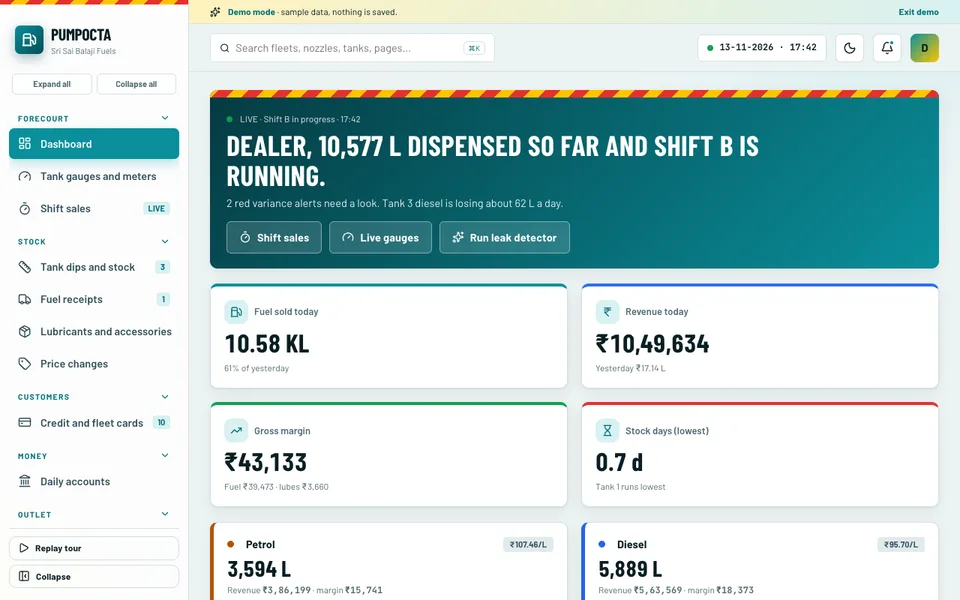
PumpOcta is an interactive demo for petrol and CNG pump dealers, built by Zenocta around a sample outlet. All data is sample data. Nothing is saved, it resets when you refresh, and the tools in its Dip Studio are simulated, scripted rather than real models.
- Dashboard: a live shift banner, fuel sold, revenue, gross margin, lowest stock days and sales by product.
- Tank gauges and meters: tank gauges and nozzle meters with the shift variance dial.
- Shift sales: sales for the shift in progress, with a flow to close the shift and hand over.
- Tank dips and stock: dip entry and stock reconciliation.
- Fuel receipts: tanker deliveries logged against the tank stock.
- Lubricants and accessories, and Price changes: non-fuel stock and a way to revise fuel prices.
- Credit and fleet cards: about 90 sample fleets, with limits, cards and a way to change a credit limit.
- Daily accounts: a day book, deposits and bank.
- Compliance and calibration: checklists and calibration records.
- Team and roster, Reports, Settings: staff and shifts, analytics and configuration. You can switch between four roles: Dealer, Manager, Shift Operator and Accountant.
- Dip Studio: a leak detector, reorder forecaster, credit risk, price simulator, roster, compliance and WhatsApp writer. All are scripted demonstrations. They do not look at real tanks.
How to try it
Open the PumpOcta demo and use Try Demo Account on the login screen. In the sample, today's date is fixed at 13-11-2026. Start at Tank gauges and meters and look at the variance dial, then enter a tank dip, close a shift, and open Credit and fleet cards. Other industries are on the demo apps page.
Getting pump software built around your outlet
Every outlet has its own tank layout, oil company reporting, shifts and fleet customers, so useful software is shaped around them. Use the demo to mark which screens you would keep. Zenocta is a Hyderabad software studio of 11 people, whose most experienced members have more than nine years in the field, serving clients in India and abroad. We reply with a scoped, fixed-price proposal. When you are ready, tell us about your outlet, and you can see our production apps on Google Play.
Try it live
Open the real thing: demos run in a new tab with sample data, apps link to their own page.
 Live demoPumpOcta live demoOpen tank gauges, nozzle meters, the shift variance dial, tank dips, fleet credit and daily accounts with sample data.
- ABrowse allAll demo appsSee the other interactive industry demos.
- ZBrowse allZenocta appsProduction apps live on Google Play.
- TBrowse allTalk about a custom buildDescribe your outlet and get a scoped, fixed-price proposal.
Frequently asked questions
01What is shift reconciliation at a petrol pump?
It is the comparison, at each shift change, of litres sold according to the nozzle meters against the fall in tank stock according to the dips, adjusted for receipts. Any gap is the variance, which the manager investigates while the shift staff are still present.
02How can software help spot a fuel leak?
By tracking variance per tank every shift and showing the trend. A leak tends to drift in one direction day after day, while dip errors scatter around zero. A steady negative trend in one tank is the signal to test the tank and lines.
03How should a pump manage fleet credit?
Give each fleet a limit, a card or vehicle list and a billing cycle, flag a sale that would cross the limit, and review ageing weekly. Deciding exceptions at the point of sale is far easier than recovering overdue balances later.
04Is PumpOcta a real product for pump dealers?
No. It is an interactive demo with sample data that shows what Zenocta can build. Nothing is saved, it resets on refresh, and the Dip Studio tools are simulated. A real system would be scoped around your outlet and quoted as a fixed-price proposal.
05Does it work for CNG as well as petrol and diesel?
The demo models an outlet with petrol, diesel, premium and CNG nozzles. A custom build would be scoped to your actual dispensers, tanks or cascades and the reporting you need, which we would agree before quoting.