In this guide
An insurance agent sells a policy once and then has to remember a date twelve months later, for hundreds of clients, while also finding new ones. When a renewal slips, the client often does not notice until a claim is refused, and by then the relationship is damaged. This guide covers what an insurance agent CRM should do for renewal tracking and commissions, and how to judge one before you commit.
It is about software for running an agency. It gives no product, regulatory or commission-rate advice. For rules, grace periods and insurer terms, check the current rules and your insurer's own documents.
Why do agents lose renewals they should have kept?
Almost nobody loses a renewal because the client chose a rival. They lose it because the reminder came late, came once, or never came. Think about how an agency usually tracks dates:
- A paper diary or a phone calendar with one entry per policy, which works until the diary is lost or the agent is travelling.
- A spreadsheet sorted by expiry date, which only helps on the days someone opens it.
- Memory, which works for the 50 best clients and fails for the next 200.
The deeper problem is that a date alone is not an action. A good system turns an upcoming expiry into a visible task with an owner, a message ready to send and a record that the message went out.
How big is the renewal job, really?
Here is a made-up agency to show the scale. An agent has 600 active policies, spread roughly evenly across the year. That is about 50 expiries a month. A 60-day look-ahead therefore holds about 100 policies at any moment, and each of those may need two or three touches before the due date. That is 200 to 300 reminders waiting in the pipeline, all the time, before a single new sale.
This is why a 60-day window is more useful than a single list sorted by date. It answers the question "what must I do this week" instead of "what exists". A circular calendar wheel is one way to show it: each upcoming expiry is a dot on a ring, so clusters jump out and a quiet fortnight looks quiet. A ladder is the second view: policies grouped into columns by how close they are to expiry, from overdue, to 0 to 7 days, 8 to 15 days, 16 to 30 days and 31 to 60 days, with two exits, renewed and lost.
A sample reminder cadence
The right cadence depends on the line of business and the client. As an illustration only, an agent might choose:
- A friendly heads-up about 45 days out, with the sum insured and premium restated.
- A second message at about 30 days with a quote if the premium has changed.
- A call at about 15 days for clients who have not responded.
- A final message in the last week, plus a note on the card if the client says they will renew elsewhere.
Whatever you choose, record each attempt on the policy. When the client says "you never told me", the history answers it in a sentence.
Tip
Language is part of the cadence. A reminder in the client's own language, short and sent on WhatsApp, usually gets a faster reply than a formal email. Keep a message template per language and let the agent edit before sending.
What belongs in an insurance agent CRM?
The core idea is one record per client that holds the whole relationship. Think of it as a client 360 view:
- Family members, with dates of birth, so that birthdays and life-stage changes prompt a conversation.
- Every policy: line of business, insurer, policy number, premium, expiry and nominee.
- Documents and identity records, with a clear status for what is missing.
- Claims, past and open, with the checklist of documents each one needs.
- Free-text notes, so a conversation from last spring is not lost when staff change.
Coverage gaps and cross-sell
Once all policies sit under one family, a simple question becomes possible: what does this household not have? A family with motor and travel cover but no health policy for the parents is a conversation worth having. A gap analysis lists lines of business a client holds against the common ones (life, health, motor, home, travel) and flags what is missing. It is not advice about what someone should buy. It is a prompt for the agent to ask, with the human deciding what is appropriate.
Leads and quotes
A lead pipeline from new, to contacted, to quote shared, to negotiation, to won gives new business the same visibility as renewals. A side-by-side quote comparison saves the agent from rebuilding the same table in a spreadsheet for every prospect. For a broader view of how small teams run messaging-led sales, see our guide to a WhatsApp CRM for small business sales teams.
Why does claims tracking decide whether clients stay?
Clients judge an agent at claim time more than at sale time. The agent usually cannot decide the claim, but can make sure nothing is missing and nothing is forgotten. A claims tracker should move each claim through clear stages: intimated, documents pending, under review, approved, settled, or rejected. Three details make it useful:
- A document checklist per claim type. A motor own-damage claim needs different papers from a health claim, and sending an incomplete set is the most common cause of delay.
- Time in stage. A claim sitting in review for longer than the insurer's turnaround time should surface on the dashboard so the agent can follow up.
- A link back to the client. When the client calls, the agent should see the claim, the policy and the family in one place.
How do you reconcile commissions instead of trusting them?
Commission is money you earn across many insurers on many dates, in different statement formats. Software cannot decide what you are owed, since terms come from each insurer, but it can store your expected amounts and show you where reality differs. Useful views split first-year and renewal earnings, show earnings by insurer, hold your rate card as a reference, and produce a payout statement per period.
Here is an invented month to show the check, with made-up amounts and no real rates:
| Insurer | Expected (₹) | Received (₹) | Difference (₹) |
|---|---|---|---|
| Insurer A | 42,000 | 42,000 | 0 |
| Insurer B | 30,500 | 27,000 | -3,500 |
| Insurer C | 18,000 | 19,000 | +1,000 |
| Total | 90,500 | 88,000 | -2,500 |
The total looks like a small gap, but the two differences point in opposite directions and hide two separate questions: why Insurer B paid less, and whether Insurer C overpaid and will correct it later. A policy-by-policy view lets you ask each insurer a precise question. Where a team shares commission, as with agents working under a manager, the split itself should be a visible calculation, not a private spreadsheet.
How do POSP teams grow without losing control?
Agencies that onboard new point-of-sale people need a pipeline for people, not only for policies. A simple one is applied, KYC and documents, training, exam and certified. Each stage should show who is stuck and for how long. The training and certification requirements are set by the regulator and change over time, so confirm them from the current rules and keep the software free of hard-coded assumptions.
For managers, the other half is targets and visibility: monthly targets per person, what each person has written, and which team members should see commission data and which should not. Role-based access is a basic requirement, not a premium feature.
Spreadsheet, diary or purpose-built software? What to ask before choosing
| Question | Diary or phone calendar | Spreadsheet | Purpose-built agency software |
|---|---|---|---|
| Upcoming renewals | One entry each, easy to miss | Sorted list, needs opening | Window, wheel and ladder with counts |
| Reminder history | None | Manual notes | Logged on the policy |
| Family view | Memory | Several rows | One client record with all policies |
| Claim documents | Paper folders | Rarely tracked | Checklist and stage per claim |
| Commission check | Not possible | Manual lookups | Expected versus received by insurer |
| Team access | Shared by handing over | Everything or nothing | Roles with hidden sections |
Questions for any vendor
- Can I see every policy expiring in the next 60 days in one view, and send a reminder from that same view?
- Is each reminder logged against the policy with date and channel?
- Can I define document checklists per claim type and add my own?
- Does it support my clients' languages in message templates?
- Who can see commission data, and can I hide it from staff?
- Can I export all clients and policies if I move away?
- How is client personal and identity data protected and where is it stored?
Common mistakes
- Treating reminders as marketing. They are service messages: short, specific and tied to the client's own policy.
- Importing duplicate clients. One family spread across three records defeats gap analysis. Merge first.
- Automating everything. Keep a human step for high-value renewals and for any client who has had a claim.
- Letting AI replace judgement. Writing aids and summaries save time, but the agent must check anything that goes to a client.
What the InsureOcta demo shows
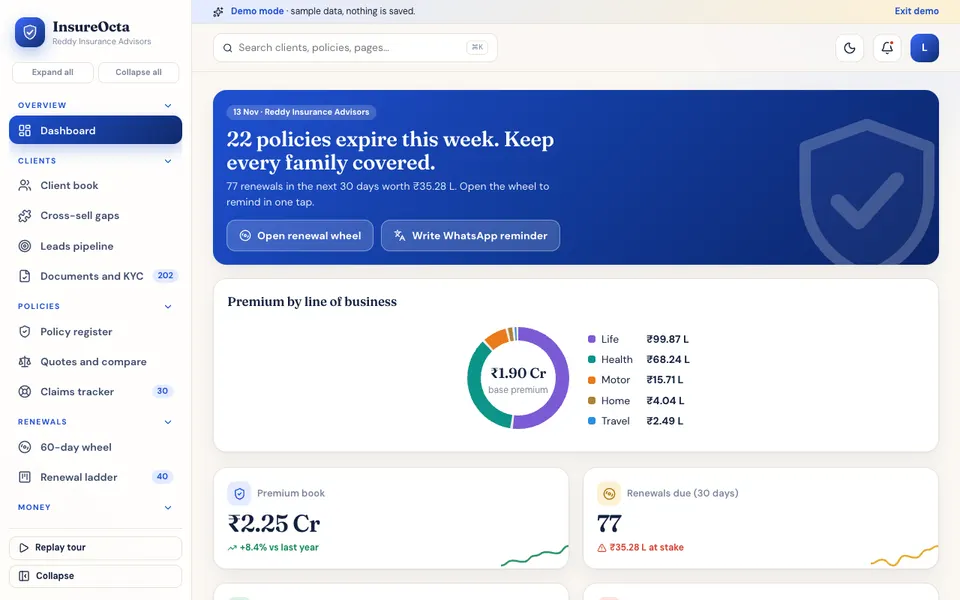
InsureOcta is an interactive demo for insurance agents and POSP teams, built by Zenocta to show what a custom agency system could look like. It runs in the browser on desktop, tablet and phone, in light or dark. It uses made-up data (about 300 clients and 450 policies across fictional insurers), nothing you do is saved, the data resets on refresh, and every AI-style tool is simulated.
- Dashboard. Premium book, renewals due, commission and open claims, plus a renewals-this-week list, birthdays and claims beyond turnaround time.
- Client book, Cross-sell gaps, Leads pipeline, Documents and KYC. The client 360 record with family, policies, documents, claims and notes, and the gap and lead views.
- Policy register, Quotes and compare, Claims tracker. Policy details with premium breakup and nominee, a side-by-side quote screen, and a staged claims board with a document checklist.
- 60-day wheel and Renewal ladder. The signature views. Click a day on the wheel to see the list and send a WhatsApp or call reminder; drag cards on the ladder from overdue to renewed.
- Commission. Earnings by insurer, first-year versus renewal by month, a rate card and payout statements, including a POSP split.
- Reports and Team and POSP. Premium by insurer and line, renewal rate, why policies lapse, plus monthly targets and onboarding stages.
- Policy Studio. Seven simulated helpers: coverage gap analyser, lapse predictor, claim document checker, best-plan recommender, pitch writer, policy reader and a WhatsApp writer in English, Hindi and Telugu. They are scripted demonstrations, not real recommendations.
How to try it
- Open the InsureOcta demo and choose Try Demo Account on the login screen. The tour starts.
- Open the 60-day wheel, click a busy day and send a sample reminder.
- Drag a policy across the Renewal ladder, then open a client and read the gap analysis.
- Check the Claims tracker for a claim with documents pending, then open Commission.
- Run the WhatsApp writer in Policy Studio and switch the language.
The login offers four roles (Agent, POSP Manager, Team Member and Customer), and some sections are hidden for roles that should not see them. More demos are listed on the demo apps page, and our production mobile apps are under apps.
Getting an agency system built for you
Every agency has its own insurers, lines of business, languages and commission routines. A custom build starts from how your renewals, claims and statements actually work, then shapes the screens around them. Zenocta works from a scoped, fixed-price proposal: we agree the modules for a first release, such as client records, the renewal window and claims, and extend from there. To discuss it, contact us. If you are still deciding whether bespoke software is worth it for a small business, read why every MSME should invest in custom software, and for the realistic place of automation, how AI is transforming SMEs in India.
Try it live
Open the real thing: demos run in a new tab with sample data, apps link to their own page.
 Live demoInsureOcta live demoClick through the 60-day renewal wheel, renewal ladder, claims tracker, commission and Policy Studio with sample data.
- ABrowse allAll demo appsBrowse every interactive industry demo Zenocta has built.
- ZBrowse allZenocta appsProduction apps live on Google Play.
- TBrowse allTalk about a custom buildDescribe how your agency works and we will scope a fixed-price proposal.
Frequently asked questions
01What should an insurance agent CRM do?
It should keep one record per client family with every policy, document and claim, show upcoming renewals in a window such as 60 days, log each reminder sent, track claims by stage, and show commission earned by insurer and by period.
02How far ahead should renewal reminders start?
There is no single rule. Many agents begin around 45 days ahead and follow up at about 30, 15 and the final week, adjusting by line of business and client. Whatever cadence you choose, record each message on the policy.
03Can software calculate my commission?
It can store your expected amounts and compare them with what each insurer paid, policy by policy, so you can question differences. Actual terms come from each insurer, so confirm them directly and check the current rules.
04Is InsureOcta a real insurance product or agency system for sale?
No. It is an interactive demo with made-up clients, policies and fictional insurers. Nothing is saved, data resets on refresh, and the Policy Studio helpers are simulated. It shows what Zenocta can build for an agency.
05How do I get an agency system built?
Tell Zenocta how you track renewals, claims and statements today. We scope the modules for a first release and send a fixed-price proposal. Start through the contact page and we will take it from there.