In this guide
A small lender runs on two clocks. One is the EMI calendar: which instalments fall due today and which are already late. The other is the collection agent's day: which doors to visit, in what order, with how much cash in the bag at closing time. When both live in notebooks and a spreadsheet, the lender finds out about a bad month in the middle of the next one. This guide explains what loan management software for small lenders should do, with a focus on EMI schedules and collections.
It describes software only. It gives no lending, regulatory, interest-rate or KYC rule advice. Wherever a rule, limit or disclosure matters, check the current rules and your own compliance advisers.
What do an NBFC, a microfinance lender, a chit fund and a gold loan shop have in common?
They look different from outside, but the day-to-day mechanics are close:
- Money goes out against a promise of repayment on a schedule.
- Each customer has an identity file that must be complete before money moves.
- Someone must collect, often in person and often in cash, then bring the money home and reconcile it.
- Late accounts need a clear escalation path, and managers need a few honest numbers about the health of the book.
The differences sit at the edges: a gold lender values ornaments, a microfinance lender meets groups of borrowers at a centre, and a chit fund runs auctions among subscribers. Good software has one common core (applications, loan accounts, receipts, overdue tracking) and add-on modules for each variation.
Where do loan applications stall?
An application usually moves through five stages: lead, KYC and documents, underwriting, sanction and disbursal. Most delay happens in the second one, for the plain reason that a customer sends three of seven documents and the file sits. A pipeline board makes this visible: you can see how many files are waiting on documents, how long each has waited and who is responsible.
A document checklist per application keeps the process steady. Typical items are identity and address proof, a photograph, income proof, a bank statement and, for secured loans, a collateral or gold declaration. The exact set depends on your product and on the rules that apply to you, so confirm it from the current rules and set it once as a template. Tick-boxes for each item, plus a clear status for identity and credit checks, tell a loan officer in a glance whether a file is ready for a decision. Keep any automated check labelled for what it is: a helper that reads a document, not the decision itself.
Flat or reducing: how do EMI schedules differ?
An EMI is a fixed monthly payment that covers some principal and some interest. The two common ways of quoting interest give very different headline numbers for similar real cost.
- Flat rate charges interest on the original amount for the whole term, as if the balance never fell.
- Reducing balance charges interest on what is still owed each month, so the interest part shrinks as principal is repaid.
Here is an illustration with made-up rates, for a loan of ₹1,00,000 over 12 months. These are not recommended or typical rates.
| Method | Quoted as | Monthly EMI (₹) | Total interest (₹) |
|---|---|---|---|
| Flat | 10% a year on the original amount | 9,167 | 10,000 |
| Reducing balance | 1.5% a month on the balance | 9,168 | about 10,016 |
The two loans cost almost the same, yet one is quoted as 10% a year and the other as 18% a year (1.5% times 12). This is why a schedule must show the method and why a calculator that puts both side by side is worth having. Here is the start of the reducing-balance schedule, rounded to whole rupees:
| Month | Interest (₹) | Principal (₹) | Balance after (₹) |
|---|---|---|---|
| 1 | 1,500 | 7,668 | 92,332 |
| 2 | 1,385 | 7,783 | 84,549 |
| 3 | 1,268 | 7,900 | 76,649 |
Notice that the interest part falls each month while the EMI stays the same. A loan account page should show this schedule, mark which instalments are paid, and record each payment against the right instalment. Disclosure of rates and fees to the borrower is governed by rules you must check separately.
What does an overdue ladder tell you, and which two numbers matter?
Group every loan by days past due. A common ladder is current, 1 to 30 days, 31 to 60, 61 to 90 and over 90. Each rung implies a different action: a friendly reminder, a visit, a promise to pay, a senior call, a recovery step. A board where accounts can be dragged from one rung to the next, or cured back into a better one, makes the escalation path explicit instead of verbal.
Two numbers summarise the book for a manager:
- Collection efficiency: what you collected divided by what fell due in the period.
- Portfolio at risk: the outstanding principal on accounts past a chosen number of days, divided by total outstanding principal.
An invented example: a branch had ₹40,00,000 of instalments due this month and collected ₹37,60,000. Collection efficiency is 37,60,000 divided by 40,00,000, which is 94%. The same branch has ₹1,50,00,000 outstanding, of which ₹6,00,000 sits on accounts more than 30 days late. Portfolio at risk over 30 days is 6,00,000 divided by 1,50,00,000, or 4%. Track both by branch and by agent, because a healthy average can hide one weak route. How accounts are formally classified and provisioned is set by regulation, so confirm those rules separately.
Tip
Define each metric once, in writing, and make the software use exactly that definition. Two managers who calculate "portfolio at risk" differently will argue about the data when they should be discussing the borrowers.
How should field collection be organised?
Collection is a routing and cash-handling problem. Three practices make it manageable:
- Give every agent a route. A list or map of stops for the day, coloured by how overdue each account is, so the most urgent stops are not left to the end.
- Record the outcome at the door. Either a collection, with the amount and mode, or a promise to pay with a date. A promise is a dated commitment you can follow up, not a vague note.
- Reconcile cash the same day. A cash book that sums receipts by mode, and a physical count at closing, so a shortfall is found while the agent still remembers the stops.
Payment modes matter because each has a different failure: cash needs counting, UPI needs matching, a bank mandate can bounce, a cheque can be returned. The same logic of route plus same-day reconciliation applies to other cash-heavy field businesses, as in our guide to courier franchise software and COD reconciliation.
Gold loans, chit funds and group lending: three special cases
Gold loan valuation
A gold loan starts with an appraisal: net weight, purity and the day's gold rate give a value, and a loan-to-value ratio caps the amount lent. Take a made-up example: 20 grams of 22-carat ornaments (916 purity) is 20 times 0.916, or 18.32 grams of pure gold. At an invented rate of ₹7,000 per gram, that is ₹1,28,240. At an invented limit of 70%, the loan would be ₹89,768. The rate moves daily, so the software should also watch each open loan against the current rate and flag when the ratio drifts, so someone acts before the margin disappears. Limits and procedures are set by regulation and your policy, so check the current rules.
Chit fund groups
A chit needs a subscriber ledger, a monthly auction record and a clear view of who has won, who has paid and what discount was bid. An auction simulator is useful for explaining to subscribers how the discount affects the dividend. Chit rules vary by state, so confirm them from the current rules before you configure anything.
Joint-liability groups
Microfinance often works through groups that meet at a centre. The software should list members per group, the instalments expected at the meeting and attendance, so the officer arrives with the right collection sheet and leaves with a recorded result.
Spreadsheet, paper or purpose-built software? What to ask before you commit
| Question | Paper registers | Spreadsheet | Purpose-built loan software |
|---|---|---|---|
| EMI schedules | Written per loan | Formulas copied per row | Generated, with payments matched |
| Overdue aging | Monthly manual count | Filtered by hand | Live ladder by bucket |
| Collection routes | Verbal instructions | Sorted lists | Route with outcomes recorded |
| Cash reconciliation | End-of-day tally | If entered | Cash book and physical count |
| Branch comparison | Not practical | Several files | Branch and agent league |
| Audit trail | Paper | Weak | Who changed what, and when |
Questions for any vendor
- Does it show both flat and reducing schedules, and which method each loan uses?
- Is a payment matched to a specific instalment, with part-payments handled?
- Can I define document checklists per product?
- Can agents record collections and promises from a phone?
- Who can edit a loan, waive a charge or change a rate, and is that logged?
- How is borrower identity data stored and who can see it?
- Can I export all data if I move to another system?
A sensible rollout
- Pick one product and one branch for the pilot.
- Load existing loans with outstanding balance and the next due date, and reconcile the totals against your books.
- Start with receipts and the overdue ladder, because those show value within a week.
- Add routes for agents once the data is trusted.
- Add gold, chit or group modules last, one at a time.
Common mistakes
- Loading unreconciled balances, so the first report is already wrong.
- Letting an AI-style credit helper replace the lending decision.
- Giving all staff edit access to rates and charges.
- Ignoring the cash book because field staff find it tedious. Make recording take seconds.
What the LoanOcta demo shows
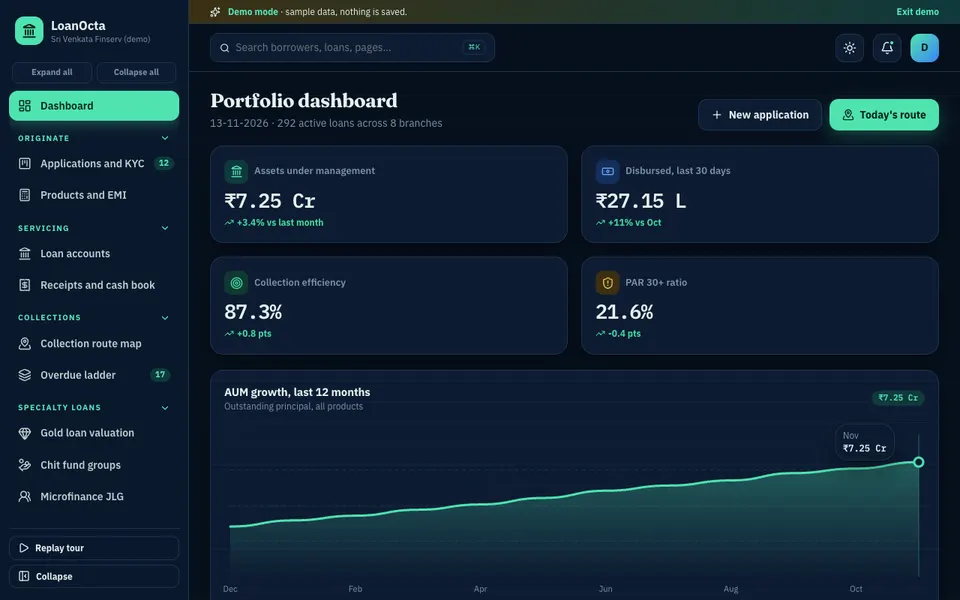
LoanOcta is an interactive demo of lending and collections for NBFCs, microfinance, chit and gold lenders, built by Zenocta to show what a custom system could hold. It runs in the browser on desktop, tablet and phone, in light or dark. All data is synthetic, nothing you do is saved, the data resets on refresh, and every credit helper is simulated. The gold valuation uses sample data and sample rates.
- Dashboard. Assets under management, disbursements, collection efficiency, PAR buckets, AUM by product and a branch league.
- Applications and KYC. A drag pipeline with a document checklist and simulated identity and bureau checks.
- Products and EMI. An EMI calculator that compares reducing and flat methods, with the full repayment schedule.
- Loan accounts, Receipts and cash book. Account detail, payment recording, a cash book and a physical cash count.
- Collection route map and Overdue ladder. Routes with stops coloured by the ladder, where you record a collection or a promise to pay, and a drag board by days past due.
- Gold loan valuation, Chit fund groups, Microfinance JLG. An appraisal slip from weight, purity, rate and LTV; an auction simulator and subscriber ledger; and centre meeting screens.
- Reports and NPA, Agents and branches. Asset classification and provisioning views, PAR trend and collection efficiency trend, with roles for Admin, Branch Manager, Loan Officer and Collection Agent.
- Credit Studio. Seven simulated tools: credit decision, KYC reader, route optimiser, promise-to-pay, gold purity, NPA radar and a Hindi and English script writer. They are scripted demonstrations, not real credit advice.
How to try it
- Open the LoanOcta demo and choose Try Demo Account on the login screen, then follow the tour or skip it.
- Open Products and EMI and compare flat and reducing for the same amount.
- Open the Collection route map, click a stop and record a promise to pay.
- Drag an account across the Overdue ladder, then run the gold valuation with different purities.
- Press Ctrl or Cmd plus K to open the command palette.
More demos are on the demo apps page, and Zenocta's production mobile apps are under apps.
Getting lending software built for your business
Your products, branches, collection routines and compliance reporting are specific to you, and a custom build starts from them rather than from a template. Zenocta works from a scoped, fixed-price proposal: we agree the modules for a first release, such as the core loan book, receipts and the overdue ladder, and add the specialty modules afterwards. To discuss it, contact us. Our note on how MSMEs reduce costs through digital transformation explains why starting small and measuring the result works.
Try it live
Open the real thing: demos run in a new tab with sample data, apps link to their own page.
 Live demoLoanOcta live demoClick through applications, the EMI calculator, route map, overdue ladder, gold valuation and Credit Studio with sample data.
- ABrowse allAll demo appsBrowse every interactive industry demo Zenocta has built.
- ZBrowse allZenocta appsProduction apps live on Google Play.
- TBrowse allTalk about a custom buildDescribe your products and branches and we will scope a fixed-price proposal.
Frequently asked questions
01What does loan management software for small lenders include?
Typically applications with a document checklist, loan accounts with EMI schedules, receipts and a cash book, an overdue ladder by days past due, field collection routes and reports. Gold, chit and group lending usually add their own modules.
02What is the difference between flat and reducing-balance interest?
Flat charges interest on the original amount for the full term. Reducing balance charges interest on what is still owed each month. Quotes in the two methods look very different even when the cost is close, so check which method applies.
03Which metrics should a small lender watch?
At least two: collection efficiency, which is collected divided by due, and portfolio at risk, which is outstanding on accounts past a set number of days divided by total outstanding. Track them by branch and agent, and check the current rules for formal classification.
04Is LoanOcta a real lending product?
No. It is an interactive demo with synthetic borrowers and branches. Nothing is saved, data resets on refresh, and the Credit Studio tools and gold valuation use simulated logic and sample rates. It does not give lending advice.
05How do I get lending software built for my business?
Share your products, branches, document checklists and collection routine. Zenocta will scope a first release and send a fixed-price proposal. Start through the contact page, and compliance rules stay for you and your advisers to confirm.