In this guide
A courier franchise lives on thin margins and thick paperwork. A parcel is booked at the counter, picked up by one agent, sorted at a hub, delivered by another agent, and paid for in cash at the door, and every handover is a chance for a record or a rupee to go missing. Good courier franchise software follows the parcel and the cash with the same reference, from the first booking to the final remittance.
How a parcel and its cash travel through a franchise
Follow one cash-on-delivery parcel through a working day. A merchant calls for a pickup. A dispatcher assigns it to an agent, who collects it and brings it to the counter or hub. Staff weigh it, price it by destination, and attach a label. It is bagged with other parcels for the same destination, moved to the next hub, and handed to a delivery agent who goes out with thirty or forty others. At the door, the customer pays, the agent notes it, and at the end of the day the agent hands over cash.
In many franchises the record of this is a booking register, a few WhatsApp groups, a spreadsheet of COD amounts, and a phone call to ask where a parcel is. The weak points are consistent:
- The same parcel is typed again at each step, so numbers drift and addresses get shortened.
- Delivery agents are chased by phone for status, which the customer service desk then repeats to the customer.
- COD cash is counted at the end of the day, but not matched against specific parcels, so a shortfall cannot be traced.
- Failed deliveries are reattempted by whoever remembers, or returned without anyone deciding to.
- Merchants ask for their remittance, and the franchise has to rebuild the figure from scattered notes.
The AWB: one number that connects everything
AWB stands for air waybill, and in domestic courier practice it simply means the consignment number printed on the label. The discipline is to generate it once, at booking, and never retype it. Every later event, such as scanned in at hub, loaded on a run, out for delivery, delivered or returned, is attached to that number. When a customer asks where the parcel is, the answer is a lookup, not a phone tree.
A thermal label usually carries the AWB as a barcode, the consignee and address, the weight and the COD amount to collect. Scanning the barcode at each handover is quicker than typing and removes most transcription errors.
COD reconciliation, step by step with a made-up example
Reconciliation means comparing what the system says an agent should hold with what the agent actually hands over, then settling the merchant from the verified total. Here is a small illustration with invented figures for one agent on one day.
| AWB (sample) | Status | COD to collect | System says collected |
|---|---|---|---|
| A0001 | Delivered | ₹1,499 | ₹1,499 |
| A0002 | Delivered | ₹799 | ₹799 |
| A0003 | Delivered | ₹2,350 | ₹2,350 |
| A0004 | Delivered | ₹650 | ₹650 |
| A0005 | Delivered | ₹1,200 | ₹1,200 |
| A0006 | Delivered | ₹999 | ₹999 |
| A0007 | Failed attempt | ₹1,800 | ₹0 |
| Total | ₹7,497 |
The agent hands over ₹7,297. The gap is ₹200, and because each delivered parcel is on the list, the dispatcher can ask about specific ones instead of accusing the agent in general. Parcel A0007 is not part of the cash at all: it belongs in the failed-delivery queue, not in the reconciliation.
Next comes the merchant. Suppose the franchise agreed a COD handling fee of 2 percent with this merchant (an illustrative figure, yours will differ). On ₹7,497 that is about ₹150, so the remittance is roughly ₹7,347 once the shortfall has been resolved. Franchises usually settle merchants in batches on a schedule, such as a bank transfer run, and mark each batch paid so there is a record.
Tip
Reconcile every agent every evening, not weekly. A weekly gap of ₹1,400 is an argument. A daily gap of ₹200 is a conversation, and the delivery sheet is still in the agent's bag.
What happens when a parcel is not delivered
Two terms matter here. An NDR, or non-delivery report, is the record that a delivery attempt failed and why: customer unavailable, wrong address, refused, phone not reachable. RTO means return to origin, where the parcel goes back to the sender. Every failed attempt needs a decision within a short, agreed window: reattempt tomorrow, ask the customer for a better address or time, or return it.
Without a queue, nobody owns that decision. The parcel rides along on the next run, fails again, and the merchant finds out a week later. A simple board with lanes for new, reattempt scheduled, customer contacted and return initiated gives the dispatcher one place to work from. Tracking your RTO rate as a percentage of parcels is also a useful health check, because a rising figure often points at address quality or at a particular merchant's COD orders.
Spreadsheet, paper or purpose-built software?
| Approach | Strength | Weakness |
|---|---|---|
| Booking register and notebooks | Zero setup, everyone understands it | No search by AWB, no live status, cash cannot be tied to parcels |
| Spreadsheets and WhatsApp groups | Flexible, cheap, familiar | Retyping at every step, no label printing, tracking by phone call, COD figures rebuilt by hand |
| Purpose-built franchise software | One AWB across counter, runs, hub, delivery, COD and tracking | Needs agreed rate cards, rules and staff training; overkill for a single counter with a handful of parcels a day |
Rolling it out without disturbing the day's runs
- Load your rate card first. Zones by pincode, weight slabs and merchant discounts. The counter cannot book confidently until pricing is right.
- Start at the counter. Book and label every walk-in parcel in the software, while pickups and delivery continue as before.
- Add delivery runs next. Agents get a run sheet with proof of delivery and COD amounts. Begin with one or two trusted agents.
- Switch on daily COD reconciliation. Do it before you change anything else about remittances, so you see the baseline gaps.
- Publish a tracking page for merchants. Fewer status calls is the first visible benefit.
- Introduce the failed-delivery board. Agree who decides and by when.
- Review weekly numbers. Bookings by zone, RTO rate, agent performance and top accounts.
What to ask any courier software vendor
- Does the AWB get generated once at booking and used on the label, the hub scan and the tracking page?
- Can the rate card be edited by us, by pincode zone and weight, with merchant tier discounts?
- Can we print a standard thermal label, and does it include a scannable barcode?
- Does the delivery run capture proof of delivery and COD together, and log failed attempts with a reason?
- Can we reconcile cash per agent against specific parcels, and batch merchant remittances?
- Is there a claims workflow for damage, loss, delay and COD shortfall?
- Does it work on a phone for agents and on a desktop for the counter?
- Who owns our data, and what are the hosting and support costs, quoted separately from the build?
Common mistakes in courier operations software
- Treating COD as a bookkeeping job. It is a control process. Reconcile by parcel, not by lump sum.
- Letting agents retype addresses. Mistyped lanes and landmarks cause failed attempts that a clean address would have avoided.
- Ignoring the hub. A parcel that is not scanned into a bag is invisible until it is late.
- No owner for exceptions. Claims and failed deliveries pile up quietly.
- Over-promising delivery times in the tracker. An estimate should come from your real run data, not a guess.
The wider case for replacing registers with software is covered in why every MSME should invest in custom software, and how MSMEs can reduce costs through digital transformation shows where the savings tend to come from. If your counter also issues invoices, GST billing software for small business is worth a read, and check the current rules for how your invoices must be raised.
What the CourierOcta demo shows
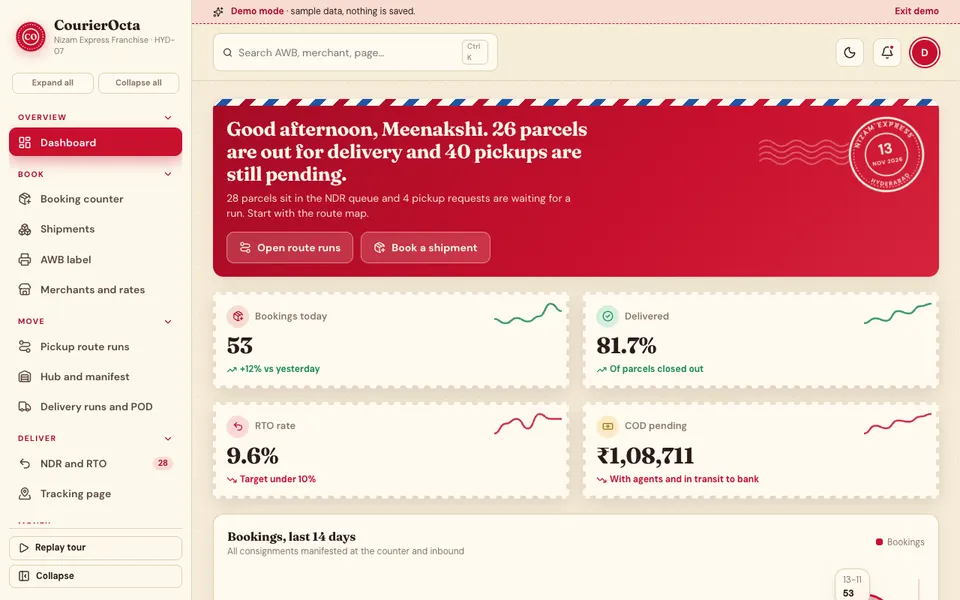
CourierOcta is an interactive demo of software for a courier or last-mile franchise, made by Zenocta. It opens with a sample franchise. Everything inside is sample data: nothing is saved, the data resets when you refresh the page, and the tools in its Route Studio are simulated, using fixed rules rather than a live AI model.
The pages you can open:
- Dashboard: bookings today, delivered percentage, RTO rate and COD pending, with a 14-day booking chart.
- Booking counter: book a consignment, see the rate by zone with GST, and print the AWB label.
- Shipments: search every consignment by AWB, consignee, merchant or city.
- AWB label: a 4 x 6 inch thermal label layout with a Code 39 barcode and a QR block.
- Merchants and rates: customer accounts with tier discounts, and the pincode-zone rate card the counter uses.
- Pickup route runs: each agent's run as a route on the city map. Drag a stop between runs and the route, distance and ETAs recalculate.
- Hub and manifest: scan parcels in, drag them into destination bags, seal them and dispatch with a bag manifest.
- Delivery runs and POD: the day's run per agent, with proof of delivery by OTP or signature, COD collection, and a way to log a failed attempt.
- NDR and RTO: a lane board for non-delivery reports, where you drag cards, schedule a reattempt or send the parcel back.
- COD reconciliation: match the cash each agent holds against the system, then batch remittances to merchants.
- Claims: damage, loss, delay and COD shortfall claims from filing to settlement.
- Tracking page: the public page a customer sees, where entering an AWB shows a stamped timeline.
- Reports, Team and Settings: bookings and revenue by zone, payment mix, agent performance, staff roles and franchise rules.
- Route Studio: an address cleaner, COD fraud and RTO risk, an ETA predictor, a delivery-failure predictor, a hub load balancer, a run route optimiser and a WhatsApp update writer. These are scripted demonstrations. No messages are sent and nothing is predicted from real data.
How to try it
Go to the CourierOcta demo and select Try Demo Account on the login screen. A skippable tour follows. A good five-minute route: book a shipment at the counter, open its label, find it in Shipments, drag a stop between two pickup runs, then open COD reconciliation and see how cash is compared with the system. Other industries are listed on the demo apps page.
Getting a franchise system built around your routes
Every franchise has its own rate card, partner network, label format and way of settling merchants, so the right system is one fitted to them. A demo like CourierOcta helps you point at screens and say keep, change or remove. Zenocta is a Hyderabad software studio of 11 people, whose most experienced members have more than nine years in the field, working with clients in India and abroad. We respond with a scoped, fixed-price proposal rather than an open estimate. If you would like to explore it, tell us how your franchise runs today, and you can also see our production apps on Google Play.
Try it live
Open the real thing: demos run in a new tab with sample data, apps link to their own page.
 Live demoCourierOcta live demoBook a sample consignment, print an AWB label, drag stops between pickup runs and reconcile COD with sample data.
- ABrowse allAll demo appsSee the other interactive industry demos.
- ZBrowse allZenocta appsProduction apps live on Google Play.
- TBrowse allTalk about a custom buildShare how your franchise runs and get a scoped, fixed-price proposal.
Frequently asked questions
01What is COD reconciliation in a courier business?
It is the daily check that compares the cash a delivery agent hands over with the COD amounts the system shows as collected, parcel by parcel. Once any shortfall is explained, the verified total is used to pay merchants in batches.
02What is the difference between NDR and RTO?
An NDR is the report logged when a delivery attempt fails, with a reason such as customer unavailable or wrong address. RTO, return to origin, is what happens when the parcel is sent back to the sender after the failed attempts are not resolved.
03Do small courier franchises really need software?
A single counter with a few parcels a day can manage with a register. Once you run several agents, pickups, COD and merchant accounts, tracing a parcel or a missing rupee by memory gets expensive, and software starts paying for itself in saved calls and recovered cash.
04Is CourierOcta a product I can subscribe to?
No. It is an interactive demo with sample data that shows what Zenocta can build for courier franchises. Nothing is saved, it resets when you refresh, and the Route Studio tools are simulated. A real system would be scoped to your operation.
05Can the tracking page be shared with customers?
In the demo, the tracking page shows what a customer would see after entering an AWB. In a custom build, a public tracking page can be part of the scope, branded for your franchise and connected to your own scan events.