In this guide
A client sends a message asking for five days in Kerala for four people. Your team builds a plan in a document, copies hotel rates from three WhatsApp chats, adds a margin in someone's head and sends a PDF. Two days later the client asks for one change, and half the numbers need redoing. This guide covers travel agency software: how an itinerary builder, quotes with margin, bookings and group departures work together.
Where does the travel sales process break?
Travel is unusual because the product is assembled from other people's products: hotels, transport, guides, tickets, sometimes visas. Every sale is a small project with its own cost sheet. That creates predictable trouble.
- Enquiries scattered across phones. One lead arrives on Instagram, another by call, another through a website form. Nobody knows who replied to whom.
- Quotes that ignore your own margin. The price is rounded in a hurry, and you find out at the end of the month that the trip earned almost nothing.
- Itineraries rebuilt from scratch. A change in hotel means re-typing days, costs and the client document.
- Supplier payments missed. A hotel deposit is due on a date nobody wrote down.
- Group tours oversold or underfilled. Seats are tracked in a sheet that three people edit.
- Documents chased late. Passport copies arrive a day before departure.
Software for a travel desk is mostly about turning one enquiry into one traceable chain: lead, itinerary, quote, booking, vouchers, payment, supplier payable, margin.
What is an itinerary builder, and why does it carry cost?
An itinerary builder lays a trip out as day columns. Into each day you place items: a hotel night, a transfer, a sightseeing activity, a meal, a flight. Each item has a cost to you and a price to the client. The point is that the itinerary and the cost sheet are the same object. Moving a night from one hotel to a cheaper one changes the day, the total and the margin at once.
A good builder also gives you three views of the same trip: the internal view with costs, a client-facing view without them, and a route view so you can see whether the days make geographic sense. A plan that sends travellers across the state and back on day two looks fine in a document and miserable in a car.
Saved itineraries matter more than they sound. Most agencies sell variations of the same twenty trips. Saving a good Kerala plan as a template, then adjusting dates and hotels for each client, turns a two-hour job into twenty minutes.
Markup or margin: which number are you quoting?
This confuses new travel teams constantly, so it is worth one worked example. Every number below is made up for illustration.
Suppose a four-person, five-day trip costs you ₹86,000 across hotels, transport and activities. You decide to add a 20% markup on cost. That is ₹17,200 (20% of 86,000), so the quote is ₹1,03,200. Now ask what share of the selling price you keep. ₹17,200 divided by ₹1,03,200 is about 16.7%. So a 20% markup is a margin of roughly 16.7% on price.
| Item (illustrative) | Amount |
|---|---|
| Your total cost | ₹86,000 |
| Markup at 20% of cost | ₹17,200 |
| Quote to client | ₹1,03,200 |
| Margin as a share of price | about 16.7% |
Neither number is wrong, but mixing them leads to quotes that quietly lose money. Decide which one your business uses, show both on the internal quote screen, and let the software do the arithmetic. Taxes and any collection at source on travel packages are rules that change, so check the current rules with your accountant rather than hard-coding assumptions.
Tip
Quote in tiers when a client is undecided. A comfortable plan and a premium plan side by side, each with its own margin, often closes faster than one number, and you control which one earns more.
How do group departures differ from custom trips?
A custom trip is built for one client. A group departure is a fixed trip on a fixed date that you sell seat by seat. The maths and the risks are different.
A group departure has a seat limit, price tiers (for example early-bird, standard and last-minute), a waitlist, and a minimum number of travellers below which the trip may not run. The danger is overbooking: if you sell 32 seats on a 30-seat coach, someone will be disappointed. A seat meter that fills as bookings arrive, with a clear warning when you cross capacity, protects you. A waitlist then lets you offer a cancelled seat to the next person in order.
Think of group departures as inventory. Each one has a break-even point. If fixed costs for a 30-seat departure are ₹3,00,000 (a made-up number), then each seat must contribute ₹10,000 on average just to cover costs, before any profit. Seeing the seat count against that number each morning tells you when to push promotion.
Why do supplier payments and traveller documents belong in the same system?
A booking is not finished when the client pays you. You still owe hotels, transport operators and guides, usually on different dates, and those dates are rarely the same as when your client pays. A supplier payments list sorted by due date shows what you must pay this week, and which of those trips have already been paid for by the client. That one view prevents the awkward call from a hotel that has not received its deposit.
Traveller documents follow the same logic. For each traveller, a checklist of what is needed, such as passport details, a photo or an entry form, shows who is still missing something. The rules about what a trip requires change by destination and over time, so treat any checklist as your own working list and confirm requirements from official sources. The point of the software is that the list exists, is visible and is not chased from memory.
How do you roll out travel software in a small agency?
- Start with enquiries. Put every lead in one pipeline with a source and a next action. This alone ends the "who replied?" problem.
- Save your top ten itineraries as templates. Use your real bestsellers, with current supplier costs.
- Load suppliers and rates. Hotels, transport operators and guides, with validity dates for each rate.
- Quote from the builder for two weeks. Compare the margin shown with what you actually earn, and correct any hidden costs.
- Turn accepted quotes into bookings. Make the booking record the place where payments, documents and vouchers live.
- Add group departures and supplier payments last. They matter, but they need the earlier steps to be trustworthy first.
Spreadsheet, paper or purpose-built software?
| Need | Paper and WhatsApp | Spreadsheet and documents | Purpose-built software |
|---|---|---|---|
| Enquiry tracking | Scattered chats | A list someone updates | Pipeline with stages and next steps |
| Itinerary with cost | Retyped each time | Document plus separate cost sheet | One builder, cost and margin live |
| Quote to booking | Manual re-entry | Copy and paste | Accepted quote creates the booking |
| Group seats | Counted by hand | Shared sheet, edit clashes | Seat meter, tiers and waitlist |
| Traveller documents | Photos in chats | Folder per trip | Checklist per traveller |
What to ask any vendor or developer
- Is the itinerary the same record as the cost sheet, so a change updates both?
- Can I see markup and margin side by side, and set a default per trip type?
- Can I hide costs in the client view but keep them in the internal view?
- Does an accepted quote create a booking without retyping?
- Does the group departure warn me before I overbook, and does it manage a waitlist?
- Are supplier payment due dates visible in one list?
- Who owns the traveller data, and can I export it?
Common mistakes
Quoting before the supplier rate validity is checked is the classic one: the hotel price in your sheet expired last month. Another is a single flat margin for every trip, when a complex multi-city plan deserves more than a simple transfer. A third is treating documents as a late task. Collecting passport details early, and showing which travellers are still missing them, prevents a stressful last week.
What the TravelOcta demo shows
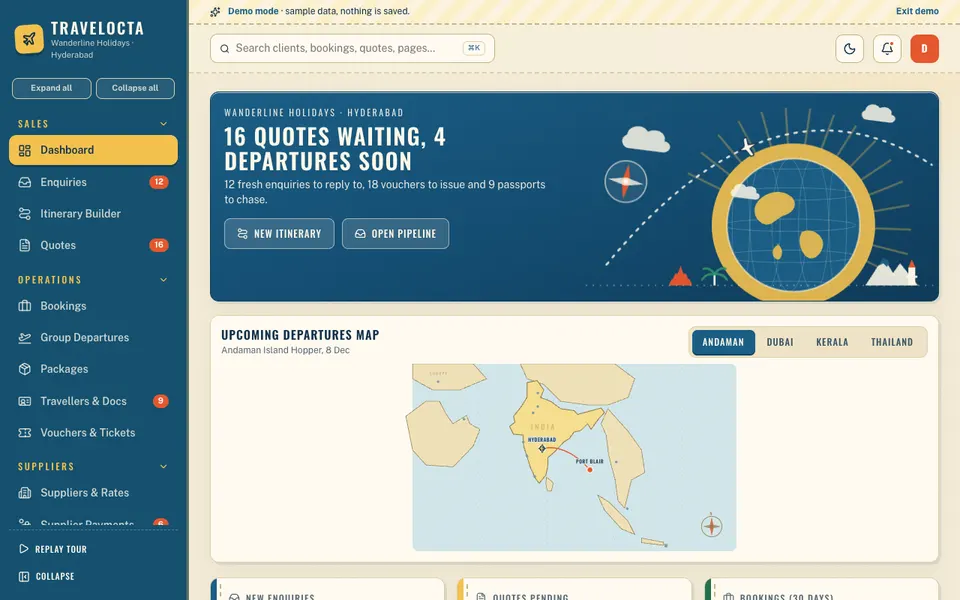
TravelOcta is an interactive Zenocta demo for travel agencies, destination management companies and group-tour operators, built around a fictional Hyderabad agency called Wanderline Holidays. It runs on sample data, nothing is saved and it resets on refresh. Every "AI" feature is simulated and rule-based, not a real model. Here is what it contains.
- Sales: a Dashboard; Enquiries as a drag-and-drop pipeline; the Itinerary Builder with day columns, drag and drop, cost and margin, a route map, a client preview and saved itineraries; and Quotes shown as ticket cards, with a client phone portal where accepting a quote creates a booking.
- Operations: Bookings; Group Departures with a seat meter, price tiers, a waitlist and an overbooking warning; Packages; Travellers and Docs as a passport-stamp checklist; and Vouchers and Tickets.
- Suppliers: Suppliers and Rates, and Supplier Payments.
- Money: Payments and Invoices, and Commissions and Margins.
- Insights: Analytics in four tabs, Settings and the Trip Studio.
The Trip Studio contains seven simulated tools: an itinerary generator, a quote optimiser, a lead scorer with a first reply, a visa and document checker (using illustrative rules only, so always check the current rules for any real trip), a best-time planner, a WhatsApp enquiry bot and an upsell and rate comparer. Tax and currency exchange figures in the demo are illustrative. On touch screens, a plus button replaces drag and drop.
How to try it
Open the demo and choose Try Demo Account on the login screen. Build an itinerary, watch the margin move as you swap a hotel, send it to Quotes and accept it from the client phone portal to see the booking appear. The demo apps page has other industries to explore.
Getting a travel system built around your agency
An outbound leisure agency, an inbound tour operator and a pilgrimage group organiser all price and sell differently. Zenocta builds custom software around your workflow: we start with how a trip moves from enquiry to return, then send a scoped, fixed-price proposal. You can talk to us about a custom build, or see what we have shipped on the apps page. If your leads come through chat, read our guide to a WhatsApp CRM for sales teams. If you manage a stay property as well, see hotel and homestay software. For invoicing basics, our post on making a GST invoice is a good companion.
Try it live
Open the real thing: demos run in a new tab with sample data, apps link to their own page.
 Live demoTravelOcta live demoOpen a sample agency: enquiry pipeline, itinerary builder with margin, quotes, bookings and group departures.
- ABrowse allAll demo appsBrowse every interactive demo, each with a sample company and nothing saved.
- ZBrowse allZenocta appsProduction apps live on Google Play.
- TBrowse allTalk about a custom buildTell us how your agency runs and get a scoped, fixed-price proposal.
Frequently asked questions
01What should travel agency software include?
At minimum: an enquiry pipeline, an itinerary builder that carries cost and margin, quotes that turn into bookings, supplier rates and payments, traveller documents, and group departure seat tracking. Everything else is a bonus on top of that chain.
02What is the difference between markup and margin on a travel quote?
Markup is the amount added to your cost, expressed as a share of cost. Margin is your profit as a share of the selling price. A 20% markup gives roughly a 16.7% margin, so quote with the right number in mind.
03How do group departures differ from custom itineraries?
A custom trip is built and priced for one client. A group departure is a fixed trip sold seat by seat, with a capacity, price tiers, a waitlist and often a minimum number of travellers to run.
04Is the visa checker in the demo reliable?
No. The TravelOcta visa and document checker is a simulated, rule-based tool with illustrative rules only. Visa and entry rules change, so always check the current rules from official sources for a real trip.
05Can Zenocta build custom software for a travel agency?
Yes. Zenocta builds custom software around how your agency sells and operates. We start with your workflow and return a scoped, fixed-price proposal. The TravelOcta demo uses fictional data and is not a product for sale.