In this guide
A jewellery shop sells a product whose price moves every day, whose value sits in weight and purity rather than in a barcode, and whose raw material is regularly handed to craftsmen outside the shop. A school notebook and a calculator can carry that for a while, but not for long. This guide explains jewellery shop software: how a bill is built, why tag-wise stock matters, and how saving schemes and karigar jobs fit in.
Where does a jewellery shop lose track of value?
Jewellery is stock you cannot afford to lose track of, because each piece is worth a lot and looks like the next one. Common leaks are quiet ones.
- Bills calculated by hand. Weight times rate, making charge, stone, old gold deduction: a slip anywhere changes the total, and the customer or the shop absorbs it.
- Stock counted by total weight. The register says you have a certain number of grams, but not which pieces. A missing ring cannot be found because nothing says which ring.
- Rates updated in people's heads. The morning rate changes, one counter uses the new one and another uses yesterday's.
- Saving scheme chits in a notebook. Who has paid how many instalments, and who is due to redeem, depends on whoever kept the book.
- Metal sent to craftsmen without a clear record. When the finished pieces return, the weight does not match and nobody agrees by how much.
Good software turns each of these into a record that can be checked.
How is a jewellery bill built?
A jewellery bill is a short calculation with several parts. Most of the mistakes happen in the order, not the arithmetic.
- Metal value: the piece's weight multiplied by the day's rate for that purity.
- Making charge: either a fixed amount per gram or a percentage of the metal value, depending on the item and on your policy.
- Stone and other charges: any stones set in the piece, and wastage where you charge it.
- Old-gold deduction: if the customer is exchanging old jewellery, the credited value comes off.
- Tax and rounding: applied last, as per the current rules.
Here is a made-up example. Every number is invented to show arithmetic and is not a real market rate. Suppose a piece weighs 20 g and, for this example only, the rate is ₹10,000 per gram. Metal value is 20 times 10,000, which is ₹2,00,000. Making at 10% of metal value is ₹20,000. A stone adds ₹5,000. The subtotal is ₹2,25,000. The customer exchanges old gold worth ₹50,000, so the amount before tax is ₹1,75,000. We stop there, because tax treatment must follow the current rules.
The printed invoice also needs the piece details. Where a piece carries hallmark identification, the bill builder should pull it from the tag record instead of relying on someone typing it. What a bill must show, and how hallmarking works, is a matter of the current rules, so check them rather than assuming.
Tip
Add a rate lock for quotes. When a customer asks for an estimate for a wedding purchase, the shop can honour the rate for a stated time, and the software records which rate was locked and when, so there is no argument later.
Why is tag-wise stock better than weight totals?
A tag is a label on one piece. Tag-wise stock means every piece in the shop has its own record: tag number, category, metal and purity, gross weight, net weight, stone weight, making rule and where it is kept. Total grams are then the sum of the pieces, not a figure on its own.
That change gives you three things. Billing becomes a tag lookup: scan or type the tag and the weight and details fill in. A stock audit becomes a scan: walk a tray with a scanner, and the system lists which tags it saw and which it did not. And losses become specific. If the tray should hold five pieces and a scan finds four, the missing tag number tells you which piece to look for, and when it was last seen.
Start with the pieces that carry the most value. A shop with a few hundred tags can tag everything in a week, and the audit routine then pays for the effort within a month. Remember to record sold tags as sold, not delete them, so history stays traceable.
How should old gold exchange be handled?
Old-gold exchange is both a sales tool and a risk. The shop takes metal at a value that depends on its tested purity and on melt loss, the amount lost in refining. The customer receives a voucher credited against a new purchase.
A small made-up example: a customer brings 6 g of old jewellery. Testing shows 90% purity, so the pure content is 5.4 g (6 times 0.9). The shop allows 0.4 g melt loss, which leaves 5.0 g credited. At the same illustrative rate of ₹10,000 per gram, the voucher is ₹50,000, the figure used in the bill above. What matters is that purity, weight, melt loss and voucher value are recorded together, so you can explain a number to the customer and to your own accountant. Policy on purity testing and exchange terms is yours to set.
How do monthly saving schemes work in software?
Many shops run monthly saving schemes: the customer pays a fixed amount each month, and at the end of the term redeems the total against jewellery. An 11+1 style scheme is one common shape, where the customer pays for 11 months and the shop adds a benefit toward the final month. As an illustration, ₹5,000 for 11 months is ₹55,000, and a shop that adds one instalment would offer a ₹60,000 redemption value. Your own terms may be entirely different, and the rules that apply to schemes that collect money from the public vary, so check the current rules before you design or advertise one.
Software helps with the bookkeeping. A calendar of instalments per customer shows paid, due and overdue. A dues list tells the counter whom to call. Redemption should be a controlled step: the system confirms the instalments paid, applies the value to a new bill and closes the scheme. Without that, schemes become a hidden liability that nobody can total on a given day.
How do you track metal sent to a karigar?
When you give a karigar metal to make a piece, three numbers matter: what you issued, what came back and what was lost in making. Allowed wastage is agreed in advance. Consider a made-up job: you issue 100 g, you allow 2 g wastage, and the karigar returns finished pieces of 96.5 g plus 1 g of filings. Accounted for is 97.5 g, so 2.5 g is unaccounted, which is 0.5 g over the allowance. That 0.5 g is the discussion to have, and it is only a discussion if both sides can see the same issue and return entries.
A board of jobs by stage, such as ordered, issued, in progress and returned, shows which orders are late and which craftsman holds how much metal. That second figure is the one owners most want and rarely have.
How do you roll out jewellery software in an existing shop?
- Fix the rate routine. Decide who sets the day's rate and when, so there is one published rate.
- Tag your stock. Start with high-value pieces, then work down.
- Define your making rules. Per gram or percentage, by category.
- Move billing across. Run the new bill beside the old one for a week and compare totals.
- Load scheme members and instalments. Reconcile against the notebook before you stop using it.
- Add karigar jobs last. Begin with new orders rather than re-entering old ones.
Notebook, spreadsheet or purpose-built software?
| Need | Notebook and calculator | Spreadsheet | Purpose-built software |
|---|---|---|---|
| Bill calculation | By hand, easy to slip | Formulas that someone can overwrite | Built from tag, rate and your making rules |
| Stock by piece | Total grams only | A list that drifts out of date | Tag-wise records with scan audit |
| Day's rate | Passed by word | A cell people forget to update | One published rate used by all counters |
| Saving schemes | A register | Hard to see overdue at a glance | Instalment calendar and dues list |
| Karigar metal | Memory and chits | Manual tally | Issue and return with wastage |
What to ask any vendor or developer
- Is stock kept per tag, with a scan-based audit?
- Does the bill show weight, rate, making, stone, wastage and old-gold deduction as separate lines?
- Can I publish one rate for the whole shop and see its history?
- Can I set making charges per gram or as a percentage by category?
- Does it track scheme instalments, dues and redemption?
- Does it record metal issued to and returned by each karigar, with wastage?
- Do different roles see different menus, and can I export my data?
Common mistakes
Treating rates as a typing task is the first, since a wrong rate multiplies through every bill. The second is leaving old stock untagged "for later", which keeps the audit permanently broken. The third is launching a scheme without a clear written term sheet. The fourth is giving every counter staff member access to rate editing and stock deletion.
What the JewelOcta demo shows
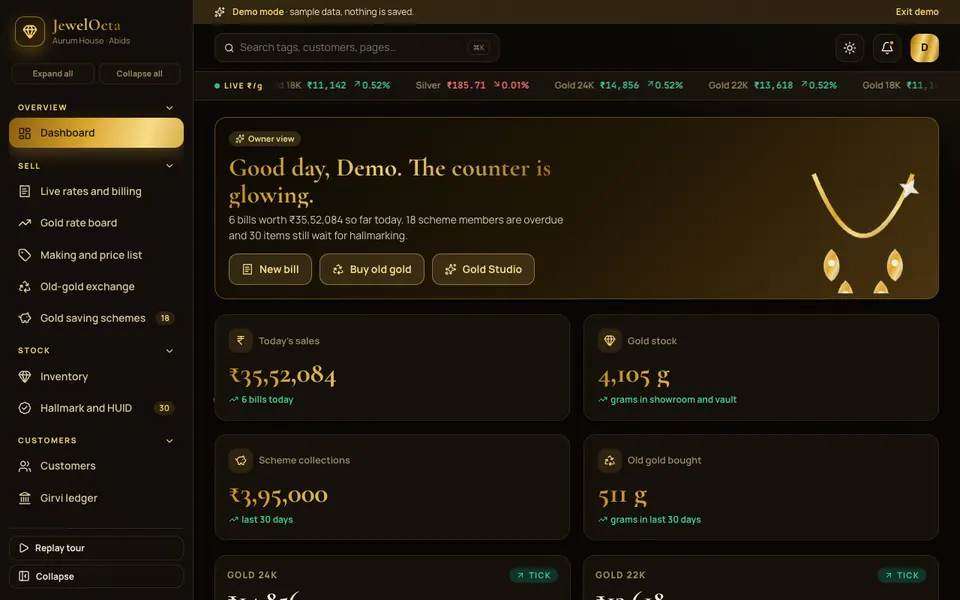
JewelOcta is an interactive Zenocta demo for Indian jewellery shops. It uses sample data and nothing is saved. Important: the metal rates in the demo are sample data, simulated for illustration, and are not real market rates. The "AI" in it is scripted, not a real model.
- Live rates and billing: the signature page, with a rate ticker for gold 24K, 22K and 18K and silver, up and down colours, mini charts, a rate lock and a bill builder: tag lookup, weight times rate, making per gram or percent, stone, wastage, old-gold voucher deduction, tax lines, round-off and a printable invoice showing hallmark details.
- Rates and prices: a Gold rate board with publish, history and alerts, and a Making and price list.
- Exchange and schemes: Old-gold exchange with purity, melt loss and voucher; and 11+1 schemes with a calendar, dues and redemption.
- Stock and compliance: Inventory with 400 tags and an audit by scan, and a Hallmark and HUID page. Check the current rules for what applies to your shop.
- Customers and ledgers: Customers, and a girvi (pledge) ledger. Rules for pledge lending vary, so check the current rules.
- Production: Orders and a karigar kanban with drag and a select fallback, issue and return with wastage.
- Other: Dashboard, Reports and Settings. The menu is filtered by role: Owner, Salesperson, Karigar Manager and Accountant.
Gold Studio has seven tabs of simulated AI: a design suggester, a photo price tool, a rate predictor (scripted, not a real forecast), scheme defaults, occasion picks, a hallmark checker and a WhatsApp message writer in English, Hindi and Telugu. The demo also has a command palette (Ctrl or Cmd plus K), a live events strip and dark velvet and ivory themes.
How to try it
Open the demo and choose Try Demo Account on the login screen, and take the guided tour if you like. On the Live rates and billing page, look up a tag and build a bill with an old-gold deduction. Then open the karigar kanban and issue a job. Other industries are on the demo apps page.
Getting a jewellery system built for your shop
A single-counter shop, a multi-branch showroom and a wholesale manufacturer need different workflows, from billing to karigar accounts. Zenocta builds custom software around how your business runs: we start by understanding your rate, billing and stock routine, then return a scoped, fixed-price proposal. You can talk to us about a custom build, or see our shipped work on the apps page. For the retail basics, read our guide to billing and inventory software for small retailers. For invoice fields, see how to make a GST invoice. For customer follow-up, see WhatsApp CRM for sales teams.
Try it live
Open the real thing: demos run in a new tab with sample data, apps link to their own page.
 Live demoJewelOcta live demoOpen a sample jewellery shop with sample rates: bill builder, tag-wise stock, saving schemes, karigar kanban and a scripted Gold Studio.
- ABrowse allAll demo appsBrowse every interactive demo, each with a sample company and nothing saved.
- ZBrowse allZenocta appsProduction apps live on Google Play.
- TBrowse allTalk about a custom buildTell us how your shop runs and get a scoped, fixed-price proposal.
Frequently asked questions
01What is tag-wise stock in a jewellery shop?
It means each piece has its own record with a tag number, metal, purity, weights and location, instead of the shop tracking only total grams. Billing then becomes a tag lookup and audits can find exactly which piece is missing.
02Are the gold rates in the JewelOcta demo real?
No. The metal rates in the demo are sample data, simulated for illustration only, and are not real market rates. Never use them for buying or selling. A real system would take rates that your shop publishes.
03How does a jewellery bill handle an old-gold exchange?
The credited value of the old gold, based on tested purity and melt loss, is deducted from the subtotal after metal, making and stone are added. Tax is then applied as per the current rules.
04Can software manage saving schemes for customers?
Yes. It can keep an instalment calendar per customer, show dues and overdue amounts, and control redemption against a new bill. The terms are yours to set, and rules for such schemes vary, so check the current rules.
05Can Zenocta build a custom jewellery shop system?
Yes. Zenocta builds custom software around your billing, stock and karigar routine, and returns a scoped, fixed-price proposal. The JewelOcta demo uses sample data and scripted features and is not a product for sale.