In this guide
A brand with five outlets can walk into each one. A brand with forty-five cannot. At some point the founder stops seeing the shop floor and starts seeing only the numbers that outlet managers choose to send, usually in a spreadsheet that arrives late, with different columns each month. Running a multi-outlet network is the discipline of seeing every outlet clearly without visiting it.
Why does a growing outlet network become hard to see?
The trouble starts when information moves by email, calls and forwarded files. Each outlet reports in its own way, so nothing adds up cleanly. The same four problems show up in almost every network.
- Sales are known late and in different formats. A weak outlet can go a month before anyone notices.
- Royalty is calculated by hand. Disputes over the sum begin because nobody trusts the basis.
- Quality checks are inconsistent. One supervisor's visit is thorough and another's is a quick walkthrough, so scores cannot be compared.
- Onboarding is a long chain of messages. New outlets wait for documents, training and stock, and nobody knows which step is stuck.
Our guide to courier franchise software shows the same pattern in another industry: when many independent operators sell under one brand, one shared record is the only thing that keeps money and standards aligned.
What does an outlet scorecard measure?
A scorecard condenses several things into one number, so that you can rank outlets and decide where to spend your attention. It works only if the inputs are chosen deliberately and the weights are agreed.
Typical inputs are sales performance against the outlet's own past, audit results, customer feedback, training completion and stock discipline. Each is converted to a score out of 100, multiplied by its weight and summed.
An invented example: an outlet scores 70 on sales, 80 on audits, 60 on customer feedback and 90 on training. With weights of 40, 30, 20 and 10 percent, the composite is 70 x 0.4 + 80 x 0.3 + 60 x 0.2 + 90 x 0.1 = 28 + 24 + 12 + 9 = 73. The number is useful because it points to a cause: feedback at 60 is the weak link, not sales.
Tip
Publish the weights to your franchisees. A scorecard people do not understand feels like a punishment. One they understand becomes a target they can aim at, and your best outlets will often show you how.
How do royalty slabs work, with a made-up example?
Many networks charge royalty as a percentage of sales, often with slabs. In a marginal slab structure, each rate applies only to the part of sales that falls inside its band, This keeps the system fair as an outlet grows, because crossing a threshold does not reprice all earlier sales.
Here is an invented monthly calculation for an outlet with sales of ₹12,00,000. The rates are made up for illustration:
| Band of monthly sales | Sales in band (₹) | Rate | Royalty (₹) |
|---|---|---|---|
| First 5,00,000 | 5,00,000 | 4% | 20,000 |
| Next 5,00,000 | 5,00,000 | 5% | 25,000 |
| Above 10,00,000 | 2,00,000 | 6% | 12,000 |
| Royalty before other charges | 12,00,000 | 57,000 | |
| Marketing fund at 2% of sales | 12,00,000 | 2% | 24,000 |
| Total before tax | 81,000 |
Tax is then added as the current rules require, so check those with your accountant. The system does the addition, but the real value is the paper trail: the same sales figures that produced the invoice are visible to both sides. Add ageing, so you can see which franchisees are late, and automated reminders, and the monthly chase becomes a routine.
Contracts and legal terms for franchising are a matter for your lawyer. Software records and calculates what the agreement says; it does not decide what the agreement should say. Check the current rules for your sector and region.
How should audits be run so the scores mean something?
An audit is useful only if two auditors would score the same outlet the same way. That needs three ingredients.
A template per type of visit
A hygiene visit and a brand-standards visit ask different things. Separate templates keep each focused, and let you weight the categories differently.
Scoring with evidence
Each line is scored and, for a failure, backed by a note or photo. A score without a reason is hard to defend with a franchisee.
Corrective actions that must be closed
A failed item creates an action with an owner and a date. Then comes the part many networks skip: a re-audit, to confirm the fix. Without it, audits become a cycle of finding the same problems each quarter.
How do stock transfers between outlets help?
When one outlet has surplus and another is short, moving stock between them is cheaper than buying new or letting items expire. A transfer needs a sender, a receiver, a quantity and an acknowledgment at both ends. The record keeps the books straight, shows which outlets are chronically over- or under-stocked and gives you the evidence to adjust each outlet's ordering pattern.
How do you bring a new outlet on board without losing track?
Onboarding is a pipeline with stages: enquiry, documents, agreement, training, set-up, launch. A kanban board with a column per stage shows where every prospect sits. Add a document checklist per prospect, so nobody has to ask "did we get the ID proof?", and an investment calculator so both sides can see a rough picture of what the outlet will cost before commitment. Training and standard operating procedures belong next to this, so a new team is trained from the same material as the old ones.
Spreadsheet, shared drive or purpose-built franchise software?
| Need | Emailed spreadsheets | Shared drive and forms | Purpose-built franchisor software |
|---|---|---|---|
| Daily sales from every outlet | Late, uneven | Better, but still manual | One consistent view |
| Royalty calculation | Hand-built | Template with formulas | Slabs applied to the same data |
| Comparable audit scores | Varies by auditor | Standard form | Templates, scoring, re-audit |
| Seeing outlets on a map | No | No | Filterable map with scores |
| Onboarding progress | Chat threads | A tracker sheet | Kanban and checklist |
Franchise management software works best when it is introduced as a shared record that benefits outlets too, not as a surveillance tool.
How do you roll out a network system without upsetting franchisees?
- Start with company-owned outlets. You can change how they report without negotiating.
- Agree the scorecard and royalty basis first. Do this with a few trusted franchisees, then publish.
- Bring sales in daily. Everything else depends on it.
- Introduce audits with a first round that is advisory. People accept a new standard more readily when the first pass is a conversation.
- Add transfers, onboarding and training last.
What should you ask a franchise software vendor?
- Can royalty be set as marginal slabs, with a separate marketing fund line?
- Can scorecard and audit weights be changed by me, without a developer?
- Can franchisees see their own numbers without seeing other outlets?
- Does it support territories and area managers with their own views?
- Can an outlet be compared with another side by side?
- How are tax settings maintained? Check the current rules.
- Does it work well on a phone for visiting auditors?
What mistakes do networks make?
- Weights nobody agreed. A hidden formula causes more arguments than a strict one.
- No re-audit. Corrective actions that are never checked are decoration.
- One scorecard for every outlet type. A kiosk and a full cafe are not comparable on the same sales scale.
- Collecting data nobody reads. Every field should earn its place in a decision.
What the FranchiseOcta demo shows
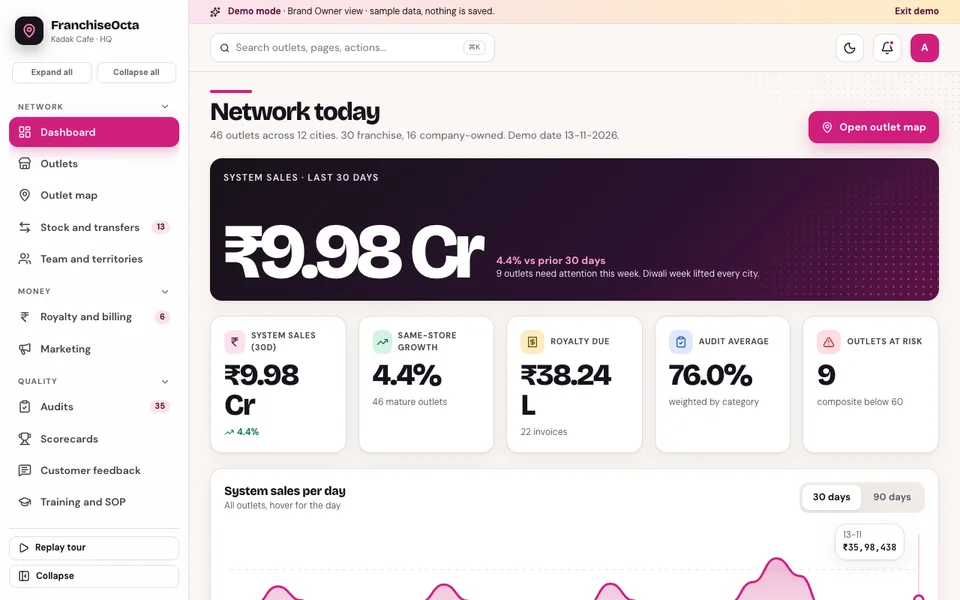
FranchiseOcta is an interactive demo for a fictional brand, Kadak Cafe, with 46 outlets (30 franchise, 16 company-owned) across 12 cities. All sales, audits, royalty and people are synthetic, nothing is saved, and data resets on refresh. The Brand Studio has seven AI-style tabs, and all of them are deterministic simulations, not a live model. It is a demonstration of what a custom build could contain and not a product with real networks behind it.
- Dashboard and Outlets. System sales, same-store growth, royalty due, audit average and outlets at risk.
- Outlet map. The signature module: pins drawn as scorecard rings, filters by city, area manager and type, a territory overlay, comparing two outlets and a scorecard drawer.
- Stock and transfers, Team and territories. Moving stock and assigning outlets to managers.
- Royalty and billing. Marginal slabs, a marketing fund, ageing, reminders and invoices.
- Audits and Scorecards. Templates, scoring, corrective actions and re-audit, with weights that can be set in Settings.
- Customer feedback, Training and SOP, Marketing. The voice of the customer and the standards for staff.
- Franchisee onboarding. A drag and touch kanban, a document checklist and an investment calculator.
- Reports and Settings. Summaries, slabs, audit weights and scorecard weights.
How to try the FranchiseOcta demo
Open the FranchiseOcta demo and pick Try Demo Account on the login screen. Begin with the Outlet map: click a pin to open its scorecard drawer and compare two outlets. Then visit Royalty and billing to see the slabs. The demo works on a tablet or phone too, with a drawer and a bottom navigation. Other sample businesses are listed on the demo apps page, and our post on why MSMEs invest in custom software explains when a custom build makes sense.
Getting a network system built around your brand
Every franchisor has a different agreement, a different fee structure and a different idea of what a good outlet looks like. Zenocta builds custom business software and also publishes its own apps on Google Play. If you would like an outlet map, royalty, audits and onboarding built around your brand, talk to us about a custom build and we will return a scoped, fixed-price proposal.
Try it live
Open the real thing: demos run in a new tab with sample data, apps link to their own page.
 Live demoFranchiseOcta live demoOpen a sample brand of 46 outlets: scorecard-ring outlet map, royalty slabs, audits, stock transfers and onboarding kanban.
- ABrowse allAll demo appsBrowse every interactive demo, each with a sample company and nothing saved.
- ZBrowse allZenocta appsProduction apps live on Google Play.
- TBrowse allTalk about a custom buildTell us how your network reports, bills and audits and get a scoped, fixed-price proposal.
Frequently asked questions
01What does franchise management software do?
It gives a franchisor one record across all outlets: daily sales, royalty and billing, audits and scorecards, stock transfers, territories, customer feedback, training and the onboarding of new franchisees, usually with maps and dashboards for head office.
02How do marginal royalty slabs work?
Each rate applies only to the portion of sales inside its band. For example, the first band is charged at one rate, the next band at a higher rate, and so on. Crossing a threshold does not change the rate on earlier sales.
03How should a franchisor score outlets fairly?
Pick a few inputs such as sales, audits, feedback and training, score each out of 100 and combine them with agreed weights. Publish the weights, compare like with like, and use the composite to find the cause, not just to rank.
04Is FranchiseOcta a real product used by networks?
No. FranchiseOcta is an interactive demo with a fictional brand, Kadak Cafe, and synthetic data. Nothing is saved, it resets on refresh, and the seven Brand Studio tabs are deterministic simulations. Legal and contract matters are for your own advisers.
05Can Zenocta build a system for my franchise network?
Yes. Zenocta builds custom business software. We begin with your fee structure, audit method and onboarding steps, then provide a scoped, fixed-price proposal covering the outlet map, royalty, audits, stock transfers and onboarding.