In this guide
A custom cake is promised for 5 p.m., the ovens are full of someone else's order, and the baker only learns about the clash when the batter is already mixed. Bakeries have a planning problem that most shops do not: every order has a deadline, every deadline needs oven time, and oven time is fixed. This guide explains how to plan it on purpose.
Why do bakeries run late when the ovens are not even full?
Most late cakes are not caused by a shortage of ovens. They are caused by two orders needing the same oven at the same hour, or by an order accepted without checking what the kitchen already had. Three habits create this.
- Orders taken by phone and WhatsApp with no shared calendar. The person at the counter promises a time the kitchen never saw.
- Details lost between the counter and the cake table. Flavour, message on the cake, weight, eggless or not, and delivery address live in three places.
- Festival weeks planned on instinct. Orders arrive in waves, and the first sign of overload is a crowded kitchen at 6 a.m.
If you also run a counter with ready items, the retail side is covered in our guide to billing and inventory software for retail shops. This article stays on the part that is unique to bakeries: custom orders, oven time and production.
What should a custom cake order capture?
A custom order is a small specification. When it is incomplete, the cake is wrong or the delivery fails, and either one means a remake. A useful order form has these fields.
- Customer name, phone and delivery or pickup choice, with the address if delivering
- Date and the time slot the cake is needed, not just the date
- Weight or tier count, flavour, filling and any dietary preference the customer states
- Message and design notes, with a reference photo if one was shared
- Advance paid and balance due
- A status that moves through booked, in production, decorated, ready and delivered
A live preview of the cake while the order is being built helps more than it seems to. The customer confirms what they see, which prevents the most common dispute: "this is not what I imagined".
Tip
Capture the time slot when the cake is needed, then work backwards. A cake needed at 5 p.m. for delivery across the city might have to be boxed by 3.30 p.m., decorated by 2.30 p.m. and baked and cooled by midday. The oven slot is the real deadline.
How does oven-board planning work?
An oven board is a timeline with one row per oven or station and one block per batch. Each block has a start time, a duration and the order it belongs to. Dragging a block moves it, and the board tells you at once if the move causes trouble. Three kinds of warning matter:
- Clash: two batches need the same oven at the same time.
- Late: a batch finishes after the time needed to decorate and deliver the cake.
- Capacity: a station has more work than it can hold in the day.
The value is catching these at booking time rather than at 6 a.m. If the board shows a clash while the customer is still on the phone, the answer can be "we can do it at 6 p.m. instead", not an apology the next morning.
How do you plan for a festival rush with numbers?
Festival demand is predictable in shape even when it is not predictable in size. The method is to take a normal day, apply a multiplier for each festival day, and compare the result with what the ovens can bake.
Here is an invented example. A kitchen can bake 40 custom cakes a day across its ovens. On a normal day it takes 30. If the festival eve brings 1.6 times the usual orders, that is 30 x 1.6 = 48 cakes, which is 8 more than capacity. Now you can decide in advance:
- Pull work forward. Sponge bases can often be baked a day earlier and frozen or stored, depending on your recipes and your own quality standards.
- Cap bookings per slot. Stop accepting orders for the busiest hours and offer the neighbouring slots.
- Add a shift or station. If 8 extra cakes are only needed for two days, an extra shift may be cheaper than lost orders.
- Move some work to a central kitchen. If you have one, send plain bases there and decorate at the outlet.
A what-if slider turns this from arithmetic into a conversation: drag the multiplier up and see which days turn red. Treat the numbers as planning aids built from your own history, not forecasts.
What does a daily production plan do?
The production plan answers a simple morning question: what do we bake today, and how much? It combines three inputs: orders already booked for today, the usual daily sales of ready items, and any festival pre-orders. The output is a list of batches with quantities, which the bakers can work through in order.
The reward is less waste. If you bake ready items by habit rather than by plan, the end of the day leaves unsold trays. A batch of 40 pastries with 3 left over is a 7.5% leftover rate (3 divided by 40). Tracked daily, that number shows which items you consistently over-bake and which you under-bake.
How do you cost a cake so the price covers the work?
Many bakers price by feel, and custom designs are where feel is least reliable. A costing sheet adds every input. Here is an invented one for a 1 kg chocolate cake:
| Cost item | Amount (₹) |
|---|---|
| Ingredients per recipe | 310 |
| Cake box and board | 40 |
| Decoration | 60 |
| Labour, 0.75 hour at ₹160 an hour | 120 |
| Gas and power share | 30 |
| Total cost | 560 |
| Selling price | 900 |
| Margin | 340, about 38% of price |
When an ingredient price changes, a recipe-linked costing sheet updates the cost of every cake that uses it. That is how you notice a favourite product has quietly stopped making money. The same discipline is useful in any small production business, as our guide to production management software for manufacturers explains.
How should ingredients, shelf-life and wastage be tracked?
Ingredient stock is bought in bulk and used in small quantities, so a purchase order list tied to recipes and production plans is more reliable than a weekly walk through the store. Shelf-life tracking records how long ready items remain good for sale, so that unsold goods are marked down or removed on time. Wastage logging, with a reason for each entry, shows whether waste comes from over-baking, damage in handling or overstock. This is operational tracking for planning; follow your own quality procedures and the current rules that apply to your business.
Spreadsheet, paper or purpose-built software?
| Need | Paper diary | Spreadsheet | Purpose-built bakery software |
|---|---|---|---|
| Custom order details | Handwritten, often incomplete | One row per order | A structured order with a preview |
| Spotting oven clashes | At 6 a.m. | Hard to see | Warned on the timeline |
| Festival what-if | Instinct | A separate model | A slider on the board |
| Cake costing | Rough | Updated by hand | Linked to recipes |
| Delivery runs | Phone calls | A list | Rider assignment with a delivery code |
What should you ask a bakery software vendor?
- Can orders carry a time slot, and can the system warn about oven clashes?
- Can I model a festival surge using my own past numbers?
- Are recipes linked to ingredient costs and to production plans?
- Does it handle both counter sales and custom orders?
- Can multiple outlets and a central kitchen work from the same plan?
- How are tax settings managed, and who updates them when rules change? Check the current rules.
- Can delivery runs be assigned to riders with a confirmation step?
What mistakes do bakeries make?
- Taking orders by date, not time slot. A date does not tell the oven anything.
- Accepting every festival order. Capping slots protects quality and sleep.
- Costing once a year. Prices of butter, cream and chocolate move.
- Ignoring small wastage. Three leftover items a day is a number worth tracking.
What the BakeOcta demo shows
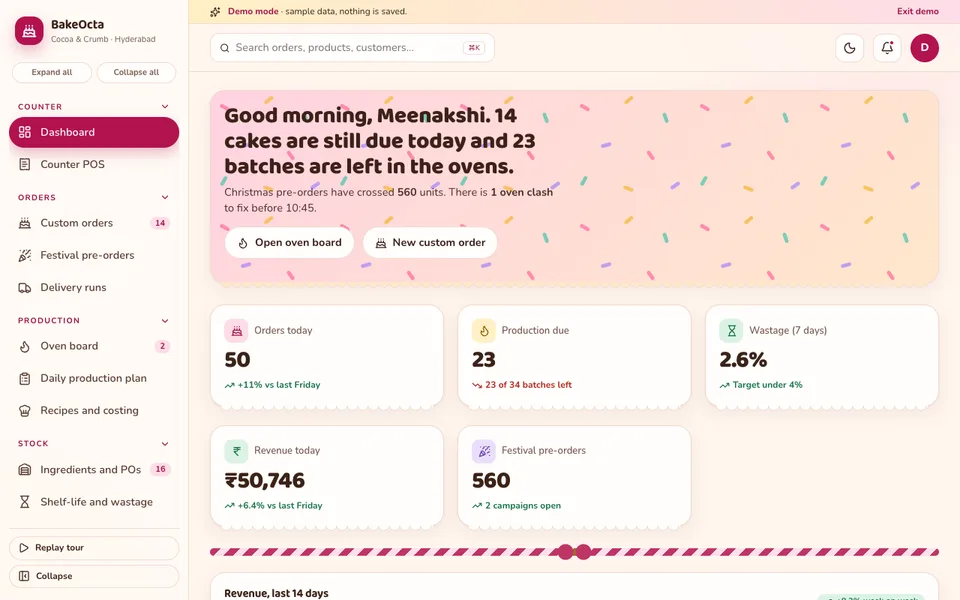
BakeOcta is an interactive demo for a sample bakery, Cocoa and Crumb in Hyderabad, with two outlets and a central kitchen. The demo date is fixed at 13-11-2026. All data is synthetic, nothing is saved, and everything resets on refresh. The festival surge is a what-if slider with sample numbers, and the Oven Studio contains seven AI-style tabs that are simulated, not live models. It is not a product with real bakeries behind it.
- Dashboard and Counter POS. Daily numbers and a counter bill with discounts, UPI, cash or card, and a custom-order add-on.
- Custom orders. Booking, a builder with live cake preview and price calculation, and a status board.
- Festival pre-orders and Delivery runs. Campaign orders, and riders with delivery codes.
- Oven board. A draggable timeline per oven or station with clash, late and capacity warnings, and a 14-day festival surge strip with a what-if slider.
- Daily production plan. What to bake today and how much.
- Recipes and costing, Ingredients and POs. Costing and purchase orders.
- Shelf-life and wastage. Items at risk and wastage tracking.
- Customers and loyalty, Reports, Team and shifts, Settings. The rest of the running of the shop.
How to try the BakeOcta demo
Open the BakeOcta demo and use Try Demo Account on the login screen. Go straight to the Oven board, drag a batch onto another and watch the warning, then drag the festival what-if slider. Afterwards open Custom orders and build a cake to see the live preview. More sample businesses are on the demo apps page, and if you also serve food on premises, our guide to restaurant POS features covers that side.
Getting a bakery system built around your ovens
A single-oven home bakery and a multi-outlet brand with a central kitchen plan very differently. Zenocta builds custom business software and publishes its own apps on Google Play. If you would like custom orders, oven planning and costing built around your kitchen, talk to us about a custom build and we will return a scoped, fixed-price proposal.
Try it live
Open the real thing: demos run in a new tab with sample data, apps link to their own page.
 Live demoBakeOcta live demoOpen a sample bakery: custom cake builder, oven board with festival surge slider, production plan, costing and wastage.
- ABrowse allAll demo appsBrowse every interactive demo, each with a sample company and nothing saved.
- ZBrowse allZenocta appsProduction apps live on Google Play.
- TBrowse allTalk about a custom buildTell us how your kitchen takes and bakes orders and get a scoped, fixed-price proposal.
Frequently asked questions
01What should bakery software include?
Counter billing, custom cake orders with time slots and a preview, an oven timeline that warns about clashes, a daily production plan, recipe costing linked to ingredients, shelf-life and wastage tracking, delivery runs and reports across outlets.
02How do I plan for a festival rush?
Take a normal day, apply a surge multiplier, and compare the result with what your ovens can bake. If demand exceeds capacity, pull work forward, cap bookings per slot, add a shift or use a central kitchen. Base multipliers on your own history.
03Why plan custom cakes by time slot instead of date?
A date gives the oven no start time. A cake needed at 5 p.m. must be baked, cooled, decorated, boxed and delivered in sequence, so working backwards from the slot shows when oven time is really needed and exposes clashes early.
04Is BakeOcta a real bakery product?
No. BakeOcta is an interactive demo with a fictional bakery and synthetic data. Nothing is saved, it resets on refresh, the festival surge is a what-if slider with sample numbers, and the seven Oven Studio tabs are simulated.
05Can Zenocta build software for my bakery?
Yes. Zenocta builds custom business software. We start with how you take orders and use your ovens, then provide a scoped, fixed-price proposal for custom orders, oven planning, production, costing and delivery.