In this guide
A customer arrives for her trial and the blouse is not ready. The master cutter says the karigar has it, the karigar says the measurements were unclear, and the notebook page with her numbers is somewhere under three other order slips. A boutique does not usually fail on talent. It fails on the small pieces of paper that sit between the order and the delivery.
Where does a boutique order go wrong between booking and delivery?
A custom garment passes through more hands than almost any retail product. One order touches the front desk, the cutter, one or two karigars, a finishing table, a trial, an alteration and finally the delivery. Each handover is a place where information is lost.
- Measurements that live in a notebook. They are copied by hand, misread, or lost when the book fills up.
- A promised date nobody can see. The date is on the slip, but the cutter plans by memory, so festival weeks turn into a pile of late orders.
- Karigar payment by guesswork. At the end of the week the owner adds up who stitched what, and every karigar remembers the total differently.
- Fabric that is neither counted nor reserved. A roll is used for a sample, the same roll is promised to a customer, and the shortfall appears on cutting day.
- Balances that go uncollected. The garment goes out with part of the money still due and nobody writes it down.
If you only want customer-facing pickup and delivery booking, our post on tailoring and laundry apps for local shops covers that side. This guide is about the other half: the workroom behind the counter.
How should an order board work in a tailoring shop?
An order board is a single view where every open garment sits in a column that matches its real stage. A typical boutique flow looks like this: booked, fabric received, cutting, stitching, finishing, trial, alterations, ready, delivered. The point of the board is not decoration. It lets the person at the front desk answer "is my order ready?" without walking into the workroom.
Three details make a board genuinely useful rather than a nice picture:
- The due date is on every card. Cards past their date should look different, so overdue work cannot hide.
- The fabric is visible. A small swatch or a colour dot on the card helps the cutter find the right piece instantly, and helps the customer recognise her own order.
- The trial is its own stage. A trial is not "ready", and it is not "delivered". It is a loop that can send the garment back to stitching, so it needs its own column and its own calendar.
What is the right way to store measurements?
Measurements are the most valuable data in a boutique and the worst kept. A good record has four properties.
One profile per person, not per order
A customer measured in January should not be measured from scratch in June. Store the set against the person, and let each new order reuse it. Families make this more useful: a mother who orders for her two daughters needs three profiles under one account, so the right set is chosen without asking again.
A history, not an overwrite
Bodies change, and so do preferences. If a new reading replaces the old one, you lose the evidence when a garment fits badly. Keep dated versions so you can say "this was taken on this date, this was the last order made from it".
A body diagram beats a list of numbers
A front-and-back outline with the points marked reduces mistakes, because the person entering the number can see which measurement it is. Shoulder, bust, waist, hip, sleeve and length are easy to swap on a plain list.
Garment notes belong with the measurements
Fit notes such as "prefers a looser sleeve" or "left shoulder slightly lower" are what make a returning customer feel known. Keep them on the same profile.
How do karigar piece-rates work, with a worked example?
Many workshops pay karigars by the piece rather than by the day. Each type of work has an agreed rate, and the weekly payout is the sum of finished pieces, less any advance already given. The arithmetic is simple. The trouble is the record.
Here is an invented week for one karigar, with made-up rates:
| Work | Pieces | Rate (₹) | Amount (₹) |
|---|---|---|---|
| Blouse stitching | 12 | 180 | 2,160 |
| Salwar suit stitching | 4 | 350 | 1,400 |
| Alterations | 6 | 60 | 360 |
| Total earned | 3,920 | ||
| Less advance already paid | 1,000 | ||
| Payable this week | 2,920 |
The arithmetic only holds if each piece is marked complete against the right karigar on the day it is finished. When completion is logged at the board, the payout builds itself during the week. When it is reconstructed on Saturday from memory, disputes are very likely.
Tip
Link every piece-rate line to an order number. If a garment comes back for rework, you can see who stitched it, and you can decide openly whether the rework is paid or not. Settle that rule with your karigars once, in plain words, before the system records it.
How do you keep fabric stock and customer fabric separate?
A boutique usually handles two kinds of fabric: material you buy and sell, and material the customer brings. Mixing them is a quiet source of loss. Customer fabric is not your stock and should never appear in your stock value, but it must be tracked just as carefully, because losing it is the fastest way to lose a customer.
For fabric you own, track the length on hand, the length reserved against open orders, and a reorder point. Reserving matters: when a roll is promised to an order, the available length drops immediately, so you do not promise the same metre twice. For customer fabric, record what was received, the length, and any marks or flaws, so there is a shared record if a question arises later.
How do you run trials and deliveries without double-booking the floor?
Trials are the most schedule-sensitive part of a boutique. The garment has to be ready, the customer has to arrive, and a trial slot is only useful if the fitting space and the person doing the fitting are free. A calendar view of trials and deliveries, one that shows the day's trials against what is due, turns this from a morning scramble into a plan.
A short alteration queue also deserves its own place. Alterations are small, fast jobs with a different rate structure and a different customer expectation, and they get buried when they share a board with long custom orders.
Spreadsheet, paper or purpose-built software?
| Need | Notebook and slips | Spreadsheet | Purpose-built shop software |
|---|---|---|---|
| Seeing every open order by stage | No | Possible, but manual | Yes, as a board |
| Reusing measurements across orders | Copy by hand | One sheet per customer gets unwieldy | One profile with history |
| Piece-rate payout | Added up on payday | Formula, if completion is logged | Built from completed pieces |
| Fabric reserved against orders | Memory | Manual updates | Reserved automatically |
| Balance due at delivery | Written on the slip | A column someone must update | Shown on the order and the bill |
| Cost to start | Almost nothing | Almost nothing | Needs a scoped build |
A notebook is fine for a one-person shop. A spreadsheet carries a small boutique a long way. Boutique and tailoring shop software starts to pay for itself when you have several karigars, regular festival peaks, and customers who expect you to remember them.
How do you roll this out without stopping the workroom?
- Start with the board. Enter only open orders, one card each, with due date and stage. Do this on day one and nothing else.
- Move measurements next. Enter profiles as customers come in, not all at once from the notebook. Within a season your active customers are in.
- Log completion at the table. Ask each karigar to hand over finished pieces to one person who ticks them off. Run the old payout method in parallel for two weeks and compare.
- Add fabric stock last. Count the rolls once, set reorder points, and then reserve against orders.
- Turn on billing and balances. Once orders are reliable, the bill and the balance due follow naturally.
What should you ask any boutique software vendor?
- Can one customer hold several measurement profiles, with dated history?
- Can the order board show due dates and fabric on each card, and flag overdue work?
- Can piece-rates be set per garment type and per karigar, and does the payout come from completed pieces?
- Does it separate customer fabric from fabric you sell?
- Can alterations and trials be handled as their own queues?
- Does it print a clear bill, and does it follow the current tax rules? Ask the vendor to confirm and check the rules yourself.
- Can you export your data if you ever leave?
Which mistakes do boutiques make with software?
- Entering history before the present. Typing in two years of old orders delays the useful part. Start with what is open today.
- Too many stages. Eleven columns that nobody updates are worse than six that everybody does.
- Skipping the karigar conversation. A piece-rate system records rates; it cannot settle disagreements about them. Agree the rate card first.
- Treating measurement as admin. The person taking measurements is the most important data-entry person in the shop. Give them a screen that is quick to use.
What the TailorOcta demo shows
TailorOcta is an interactive demo for a sample boutique, Sutra Boutique and Tailors. It uses made-up customers, orders and phone numbers, nothing is saved, and everything resets when you refresh the page. Its Style Studio contains seven AI-style tools, and they are simulated: scripted output, not a live model. It is a picture of what a custom system could contain, not a product for sale.
The modules, as the project lists them:
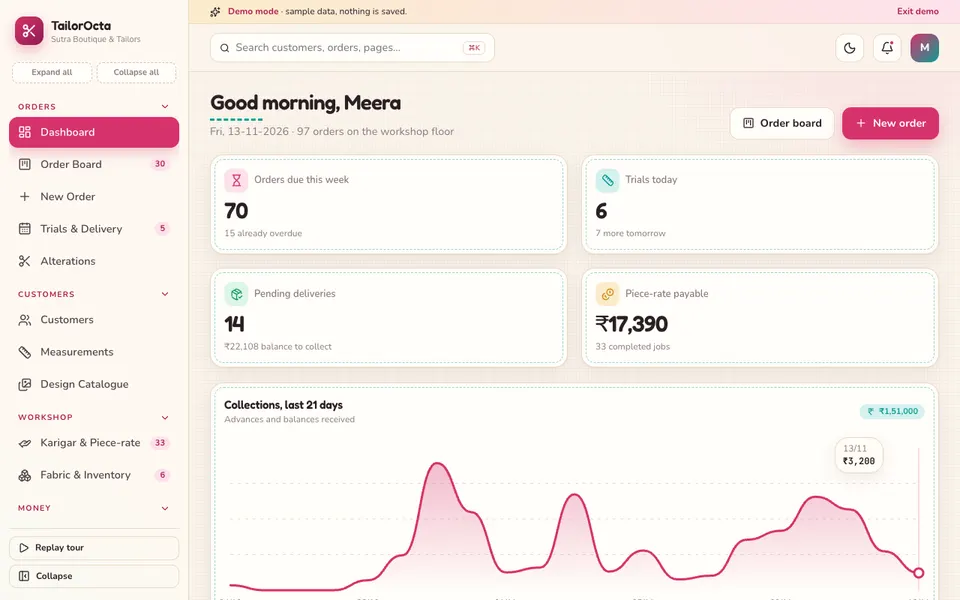
- Dashboard. A morning summary: orders due this week, trials today, pending deliveries and the piece-rate amount payable.
- Order Board with fabric swatches. Every open garment by stage, with the fabric shown on the card.
- New Order with price calculation. Booking an order and seeing the price build up.
- Trials and Delivery. The calendar view for the days ahead.
- Alterations. A separate queue for small fixes.
- Customers and Measurements. A body diagram, measurement history and family profiles.
- Design Catalogue. A browsable set of styles to start an order from.
- Karigar and piece-rate payouts. Completed work turned into amounts payable.
- Fabric inventory. Stock levels with a low-stock view.
- Billing with GST. The bill, with two GST rate options as configured in the demo.
- Reports and Settings. Summaries and the shop's configuration.
How to try the TailorOcta demo
Open the TailorOcta demo and choose Try Demo Account on the login screen. Start at the Order Board, open a card, then visit Measurements to see the body diagram and the family profiles. Finish at Karigar and piece-rate to see how finished pieces become a payout. If you prefer to compare with other industries first, the full list of demo apps shows every sample business.
Getting a boutique system built around your workroom
No two boutiques cut, stitch and trial in the same order. A bridal house, a men's tailor and a ladies' boutique with a dozen karigars each need different stages and different rate cards. Zenocta builds custom business software and also ships its own apps on Google Play. If you would like something like this shaped to your shop, tell us how an order moves today and we will return a scoped, fixed-price proposal. If you are weighing the idea, our note on why MSMEs invest in custom software is a useful starting point.
Try it live
Open the real thing: demos run in a new tab with sample data, apps link to their own page.
 Live demoTailorOcta live demoOpen a sample boutique: order board, measurements with body diagram, karigar piece-rate payouts, fabric stock and billing.
- ABrowse allAll demo appsBrowse every interactive demo, each with a sample company and nothing saved.
- ZBrowse allZenocta appsProduction apps live on Google Play.
- TBrowse allTalk about a custom buildTell us how orders move through your workroom and get a scoped, fixed-price proposal.
Frequently asked questions
01What does boutique and tailoring shop software do?
It tracks each garment from booking to delivery on an order board, stores customer measurements with history, schedules trials and alterations, tracks fabric stock, calculates karigar piece-rate payouts from completed work, and raises the bill with the balance due.
02How do karigar piece-rates get calculated?
Each type of work has an agreed rate. The payout is the sum of finished pieces multiplied by their rates, less any advance already paid. It stays accurate only when completed pieces are logged against the right karigar on the day they are finished.
03Should I store measurements per order or per customer?
Per customer, with dated versions. That way each new order reuses the latest set, family members can have their own profiles, and an old reading is kept as evidence if a garment fits badly instead of being overwritten.
04Is TailorOcta a real product I can buy?
No. TailorOcta is an interactive demo with a fictional boutique and made-up data. Nothing is saved, it resets on refresh, and the seven Style Studio tools are simulated scripts. It shows what a custom system for your shop could contain.
05Can Zenocta build a system for my boutique?
Yes. Zenocta builds custom business software. We start with your stages, rate card and measurement style, then provide a scoped, fixed-price proposal covering the order board, measurements, piece-rates, fabric stock and billing.