In this guide
Ask five agencies what a website costs and you will get five answers, because "a website" can mean a one-page card or a shop with a booking system. The useful question is not "what is the price" but "what am I paying for, and which choices move it". This guide explains website development cost in India: what a build price covers, what is billed separately, what makes a price rise or fall, and how to compare quotes fairly. It uses what Zenocta publishes on its own pricing and services pages and does not guess at market averages.
Who pays for hosting
Zenocta deploys and hosts the finished product. On white-label and custom client projects, the client pays the hosting cost, billed separately from the build price. Apps you install from Google Play and subscription products do not carry a separate hosting charge for the people who use them.
What does Zenocta say a website costs?
Zenocta's pricing page states that website design and development starts from ₹8,888 in India, and from US$99 for international clients, with delivery in as little as 7 days. The same page is clear that this is a starting price: the final figure depends on the number of pages, the features and the integrations. What the build covers, per the pricing and services pages, is a fully responsive website that works on every device, with SEO-ready structure, metadata and page speed.
Two other facts matter for planning. First, every engagement begins with a free consultation and a scoped, fixed-price proposal within 24 hours, with scope, timeline and one price in writing. No work starts until you approve it, and the scope stays what you approved. Second, the domain name and hosting are billed separately. They are not part of the build price, they stay in your name, and Zenocta helps you set them up.
Read the label
"Starting from" means the entry point for a focused site, not the price of every site. A website with many pages, a shop, booking or custom features is scoped on its own, and the proposal will tell you the price before you commit.
What is included in a website build, and what is not?
When you compare quotes, the first job is to put the same items on each list. Here is a sensible split.
| Item | Usually part of the build price | Usually billed separately |
|---|---|---|
| Design and development of the agreed pages | Yes, as written in the proposal | Extra pages beyond the agreed scope |
| Responsive layout for phones, tablets and desktops | Yes | No |
| SEO-ready structure, metadata and page speed | Yes | Ongoing SEO work after launch, if you want it |
| Domain name | No | Yes, paid separately and kept in your name |
| Hosting | No | Yes, paid separately and kept in your name |
| Blog or CMS | If included in the agreed scope | If added later |
| E-commerce, web apps and custom features | Scoped individually | Third-party fees, such as payment provider charges |
| Photos, written content and logo | Depends on the proposal, so ask | Often supplied by you or a separate provider |
| Post-launch support and maintenance | A post-launch support window is part of a project | Ongoing maintenance plans after that |
The third column is where surprises hide. A quote that looks cheap may leave out content, hosting, extra pages or maintenance, and a quote that looks expensive may include them. Ask for the list in writing.
What moves the price of a website?
Zenocta's pricing page names the main drivers: pages, features, integrations, platforms and timeline. For a website, here is how each one behaves.
| Scope item | Effect on price | Effect on time |
|---|---|---|
| Number of pages | Each page needs design, layout and checking, so more pages mean a higher price | Adds build time, and also adds time to prepare content |
| Page type: simple text page versus a rich page with a custom layout | Custom layouts cost more than standard ones | Custom layouts take longer to design and test |
| Blog or CMS | Adds setup and templates | Small addition, plus time for your first posts |
| Forms and booking | Simple contact form is modest; booking logic adds scope | Booking flows need testing with real scenarios |
| Shop or payments | Raises scope considerably: products, checkout, payment connection | Longer: product data, payment testing |
| Integrations with other tools | Each connection adds work, such as messaging, accounting, payments or existing data | Adds build and testing time |
| Login, dashboards or admin panels | Moves a website toward a web app, with a higher scope | Much longer than a brochure site |
| Motion, 3D and interactive scenes | Custom scenes need design and performance testing | Longer, especially if tuned for phones |
| Content readiness | Rarely changes the price directly | The biggest cause of delay |
| Review rounds | Extra rounds beyond the plan can change the scope | Each round adds days |
The pattern is simple: complexity and quantity cost money, and unclear content costs time. If you want the fastest, cheapest route, keep the page count modest, use standard layouts and have your content ready on day one. If you want something distinctive, expect the proposal to reflect that.
How do pages, features and integrations show up in real sites?
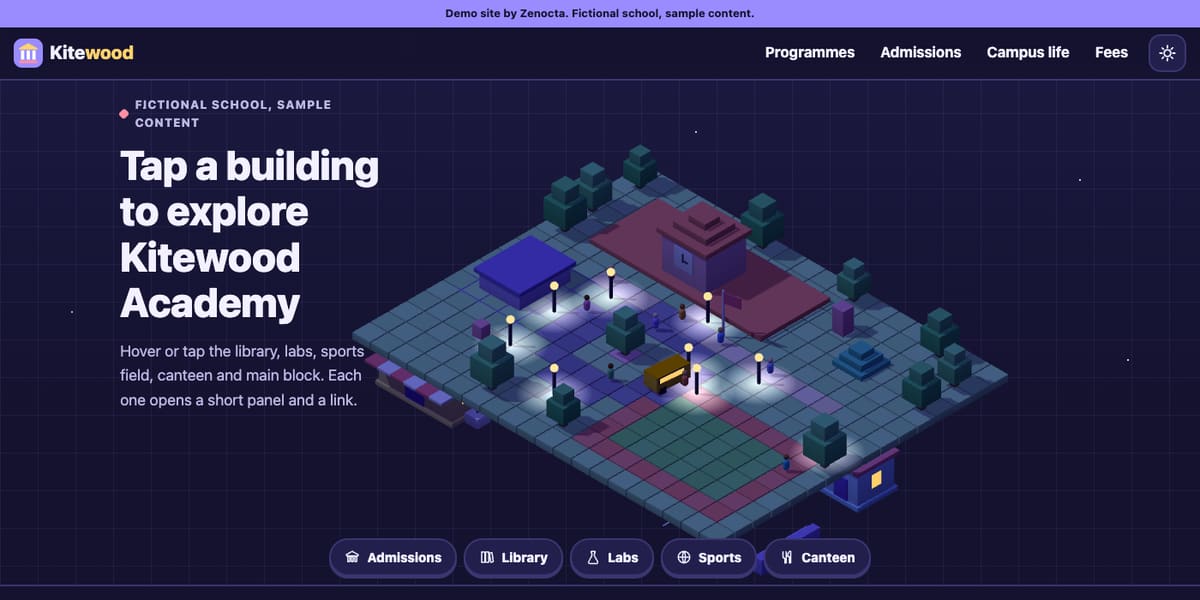
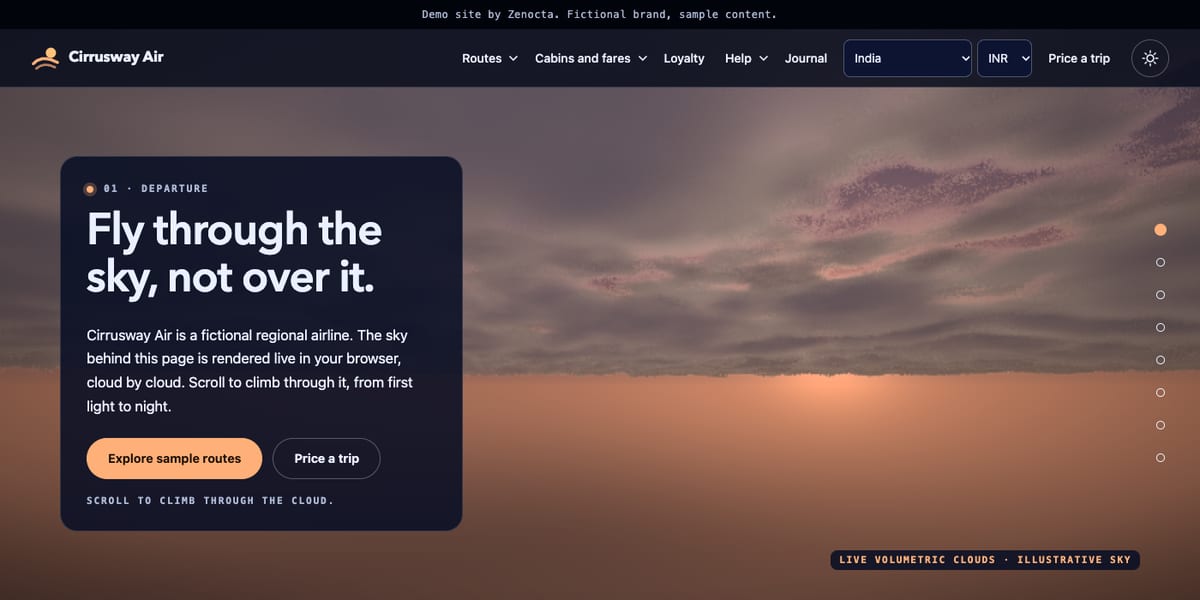
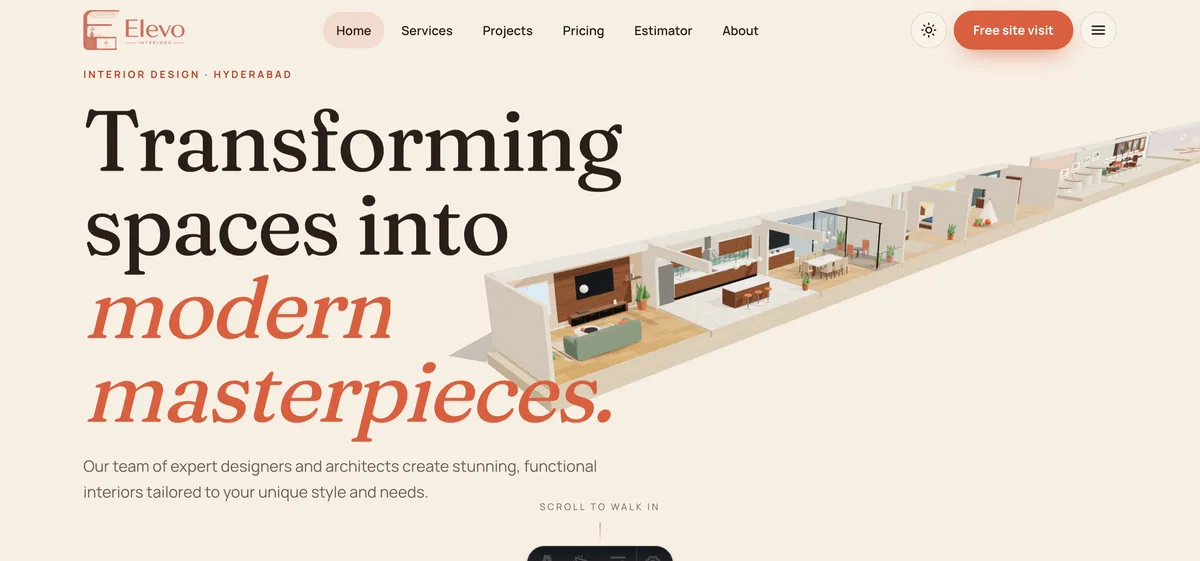
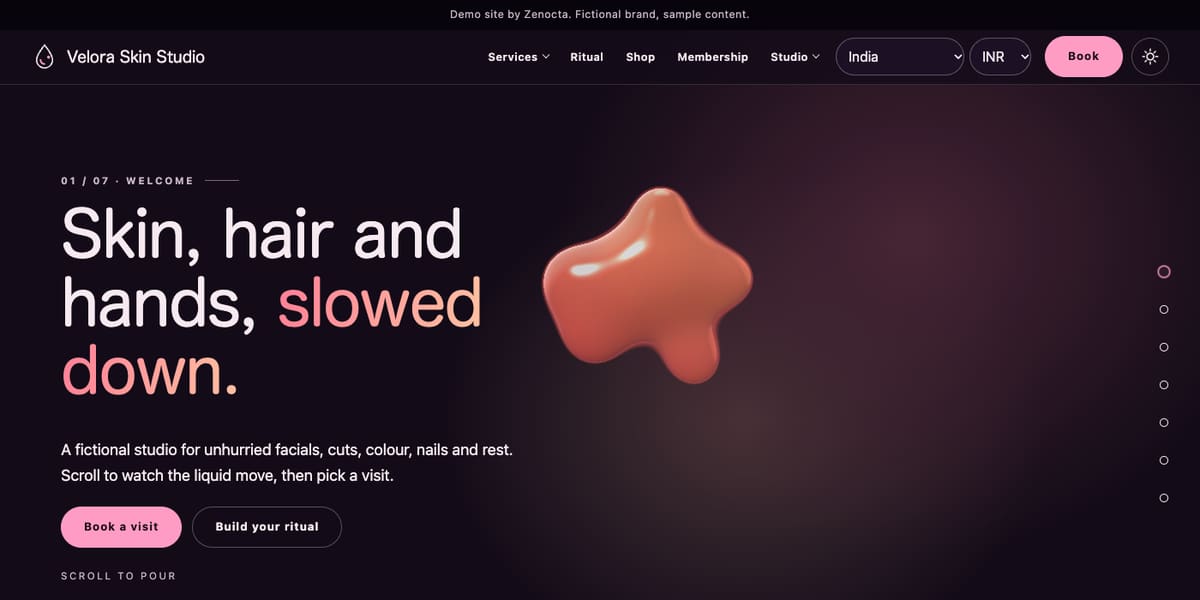
Three of Zenocta's demo websites show how scope can differ. These are showcases for fictional businesses, built to demonstrate scroll, 3D, motion and mobile layouts, so they are not price quotes. They simply illustrate how different "a website" can be.
- A lean structure. The Kitewood Academy demo is built around a few clear areas: programmes, admissions, campus, fees with a currency selector, and a journal. A school-sized structure like this is the kind of focused scope that fits the fast end of a timeline.
- A menu and a booking form. The Brewlight Café demo adds a categorised menu, a reservation page, a learn section and gift cards. More content types and a booking form mean more scope than a plain brochure.
- A large, feature-rich site. The Velora Skin Studio demo runs to around 30 pages, with a treatment menu, a ritual builder, a sample shop, a booking flow and membership plans. A site of this depth is a bigger project and would be scoped as one.
The lesson is not that one is "expensive". It is that every extra feature is a line in the proposal, so you can decide which ones earn their place.
Which costs sit outside the build price?
These are the recurring or third-party items to budget for. Zenocta does not set these, so ask each provider for current charges.
- Domain name. Registered in your name and renewed on a schedule, billed separately from the build.
- Hosting. Billed separately, and also in your name. Hosting is never part of the build price.
- Business email. A professional address on your domain is often a separate subscription.
- Third-party tools. Payment providers, booking or messaging services and paid plugins may charge their own fees.
- Content. Photography, copywriting, translation and video, unless your proposal states they are included.
- Maintenance. A post-launch support window is part of a project; ongoing maintenance plans for updates, monitoring and new features are available after that.
How do you compare website quotes fairly?
A low number is not a good deal if it leaves out half of what you need, and a high number is not a bad deal if it includes it. Compare on scope, not price alone.
- Is the price fixed once you approve it, and is the scope written down?
- How many pages are included, and what is the price of an extra page?
- Are domain and hosting charged separately, and are both registered in your name?
- Who writes the content and supplies the photos?
- How many review rounds are planned?
- Is the site responsive on phones, and is SEO-ready structure part of the work?
- What are the payment milestones, and when does ownership transfer to you?
- What happens after launch: a support window, and what do maintenance plans cost?
On the last two, Zenocta's how-we-work page says payments are typically divided into milestone-based instalments set out in the proposal and service agreement, and that ownership of custom-developed deliverables transfers to you on full payment and project completion unless otherwise specified. Whoever you choose, get the equivalent in writing.
Common mistakes that raise the real cost
- Vague scope. "A modern website" is not a scope. Pages, features and integrations are.
- Late content. Waiting for text and photos stalls the project and tempts rushed choices.
- Feature creep. Adding a shop, a booking system and a portal after the proposal is approved changes the scope and the price.
- Unlimited feedback loops. Many separate rounds from different people lengthen the schedule; gather feedback into one round.
- Ignoring the separate costs. Domain, hosting and tools should be on your budget from the start.
- Choosing on price alone. The cheapest quote can be the most expensive once omissions are added back.
How can you keep the cost sensible without cutting quality?
- Define the goal. Decide whether visitors should call, book, enquire or buy. Pages that do not serve the goal can wait.
- Start focused. Launch with the pages that matter most. A site built on a foundation that grows lets you add pages, a blog or a shop later without starting over.
- Prepare content first. Have text, photos and logo ready before the build begins.
- Prioritise features. Separate must-haves from nice-to-haves and ask the proposal to price them separately.
- Plan one review round. Gather comments from everyone, then send them together.
- Budget for the extras. Include domain, hosting and any tools in your plan.
For more on how the pieces fit together, our posts on corporate website versus landing page and why every business needs a modern website help you decide how big your first version should be. If speed matters to you, read how website speed impacts SEO and customer experience too.
What should you decide before asking for a quote?
A quote is only as precise as the brief behind it. Five minutes of thought before the consultation saves days later.
- The one action you want visitors to take: call, book, enquire or buy.
- The pages you think you need, listed even roughly, and which of them are optional.
- Any tool the site must connect to, such as a messaging app, a payment provider or a booking system you already use.
- A target date, and whether it is fixed by an event such as a launch or a season.
- Who approves the work on your side, so feedback arrives from one place.
How to get a price for your website
The quickest way to a real number is a short conversation. Tell us what your business does, who visits, what you want them to do and which pages and features you imagine. Within 24 hours you receive a scoped, fixed-price proposal, in writing, with the timeline. Read the pricing page for how a price is set, see what our website development covers, browse the demo websites to see styles and scope, and then contact us for a free consultation.
Try it live
Open the real thing: demos run in a new tab with sample data, apps link to their own page.
 Live demoVelora Skin Studio demoA large demo site of around 30 pages with a booking flow, a sample shop and memberships, to see what wider scope looks like.
 Live demoKitewood Academy demoA more focused structure of programmes, admissions, campus and fees, to compare with the larger one.
- ABrowse allAll demo websitesWorking demo sites for fictional businesses across ten sectors.
- PBrowse allPricingWebsites from ₹8,888, with a fixed-price proposal within 24 hours.
- WBrowse allWebsite developmentWhat a Zenocta website build covers and how a project runs.
- GBrowse allGet a price for your siteBook a free consultation and get a scoped proposal.
Frequently asked questions
01How much does a website cost in India?
It depends on scope. Zenocta's website development starts from ₹8,888 in India and US$99 for international clients, and the final price depends on pages, features and integrations. You receive a fixed-price proposal within 24 hours of a free consultation.
02Is hosting part of the website price?
No. Domain name and hosting are billed separately and stay in your name, and Zenocta helps you set them up. Budget for them alongside the build price, and ask every provider you compare the same question.
03Why do website quotes vary so much?
Because the scope differs: number of pages, custom design, shop or booking features, integrations, content, review rounds and support. Compare quotes line by line, in writing, rather than by the total, and check what is excluded.
04Does the price change after I approve a proposal?
Zenocta's proposals are scoped and fixed-price, and the scope stays what you approved before work begins. If you later add pages, features or integrations beyond that scope, those are new scope and would be priced as such.
05What can I do to keep my website cost down?
Launch with the pages that serve your main goal, use standard layouts where you can, prepare your text and photos early, price must-have and nice-to-have features separately, and gather feedback into one review round.