In this guide
When someone nearby searches for a dentist, a tailor or an interior designer, they see a short list, a map and a few reviews, and then they pick one in under a minute. A small business does not need tricks to be on that list. It needs a website that says clearly what it does and where, details that match everywhere they appear, a profile it looks after and reviews it earns honestly. This guide covers those local SEO basics for a small business website in India in plain, practical steps, with no ranking promises, because no honest builder can make one.
What can you actually control in local search?
Search engines weigh many signals and do not publish the full list, and results differ by person, place and time. So the useful question is not "how do I rank first" but "what is in my hands". Five things are:
- What your pages say about what you do and where you do it.
- Whether your name, address and phone number are identical wherever they appear.
- A business profile that you claim, fill in and keep current.
- Reviews that come from real customers and get real replies.
- A website that loads quickly and works properly on a phone.
Everything below is a way of doing one of those five things well.
How should page titles and headings read?
The title of a page is the line people see in search results, and the main heading is the first thing they read after clicking. Each page should have its own title and a single main heading that say plainly what the page is and, for local services, where. Write them for a person first.
| Page | Weak title | Clearer title | Why it helps |
|---|---|---|---|
| Home | Welcome | Family Dentist in Kondapur, Hyderabad | Sample Dental | Says who you are and where |
| Service page | Services | Teeth Whitening and Cleaning | Sample Dental | Matches what someone types |
| Area page | Home 2 | Dentist near Gachibowli | Sample Dental | Speaks to one place |
| Contact | Contact | Book a Visit or Call | Sample Dental | Gives the action in the title |
These are invented examples for a fictional clinic. Keep titles to a readable length, avoid repeating the same title on several pages, and put the most useful words first. Use one main heading per page, then smaller headings in order, so a visitor skimming the page, or a screen reader user jumping between headings, can follow it.
Why must your name, address and phone match everywhere?
A customer, and a search engine, should see the same business details on your site, your business profile and any directory. Small differences cause doubt, and they cause wrong turns for real customers. Here is an invented example of how drift happens.
| Where | Name | Address as written | Phone |
|---|---|---|---|
| Website footer | Sample Sweets | Plot 12, Road No. 3, Madhapur, Hyderabad | +91 98XXX XXXXX |
| Business profile | Sample Sweets and Bakery | 12 Road 3, Madhapur | +91 98XXX XXXXX |
| Directory listing | Sample Sweet House | Plot-12, Rd 3, Hitech City | 040 XXXX XXXX |
Three places, three names, two phone numbers, two localities. Pick one version of each detail, write it down as your "master copy", and use it everywhere.
- One exact business name, as it appears on your signboard.
- One address format, with the landmark or area name you want people to use.
- One main phone number that is answered during the hours you list, written the same way each time.
- Clickable phone and email links on your site, so mobile users can call in one tap.
- Opening hours that match everywhere, including special hours at festivals.
- A real map link or embedded map on the contact page.
What should you do with a Google Business Profile?
A Google Business Profile is the listing that can appear in maps and local results. It belongs to you, so treat it like a small shop window that you dress and tidy yourself. The platform sets its own rules about what you can put in it and how verification works, and those rules change, so check the current guidance from the platform before you edit anything significant.
- Claim the profile with an account the business controls, not one person's personal login.
- Choose the category that really describes your main service, and add the services you offer.
- Use your master copy of name, address, phone and hours, and link to your website.
- Add real photos of your premises, your work and your team, taken recently.
- Keep hours current, including holidays.
- Answer messages and questions quickly. A fast reply is often the difference between a visit and a missed customer.
- Review the profile once a month and fix anything that has drifted.
Own the login
If a freelancer or agency set up your profile, make sure you are listed as an owner. A profile that only someone else can edit is the local version of a domain registered in a builder's name.
How do you handle reviews honestly?
Reviews help people decide, and handling them well is mostly about being straightforward. Ask real customers at a natural moment, such as when the work is done and they are pleased, by sharing the link in a message or printing it on a card. Reply to every review, short and polite, and thank people by name where it feels right.
- Do ask every customer, not only the happy ones you pick.
- Do reply to negative reviews calmly, state what you will do, and offer to continue the conversation offline.
- Do not write reviews yourself, pay for reviews or offer rewards that bend what people say. Platforms have rules about this, so check the current guidance.
- Do not argue in public or reveal a customer's private details.
Never invent testimonials on your own website either. If you quote a customer, you need their permission and a real quote.
How much do speed and mobile layout matter?
Most local searches are made on phones, often on a mobile connection and often in a hurry. A heavy page that takes many seconds to show a phone number loses that visitor. Our post on how website speed affects search and customer experience goes into the reasons. In practice, local businesses can check a few things themselves:
- Open your site on a mid-range phone on mobile data, not only on office wifi, and note how long the first screen takes.
- Check that the phone number, address and main button are visible without hunting.
- Tap targets are large enough for a thumb, and text is readable without zooming.
- Images are sized for the screen, not full-resolution originals.
- No pop-ups cover the page before a visitor has read anything.
When do local landing pages for areas you serve make sense?
If you serve several areas, a separate page for each one can help a nearby customer see that you are relevant to them. The page must have real content for that area, not the same text with the place name swapped. Good area pages mention the services you do there, how visits or deliveries work, some local detail you actually know, and a clear way to book.
- Build area pages only for places you genuinely serve.
- Give each page its own title, main heading and opening paragraph.
- Link them from a "areas we serve" section so visitors and search engines can find them.
- Do not create dozens of thin pages. A few useful ones beat many empty ones.
Zenocta's own page on website development in Hyderabad is an example of a local page with a clear purpose. It states the office location, who the service is for, what is delivered and what starts the process, and links on to the wider website development page for clients elsewhere.
What do the demo websites show about local pages?
These are demos made for real businesses in Hyderabad, not the businesses' official sites, and their forms are not connected.
Elevo Interiors
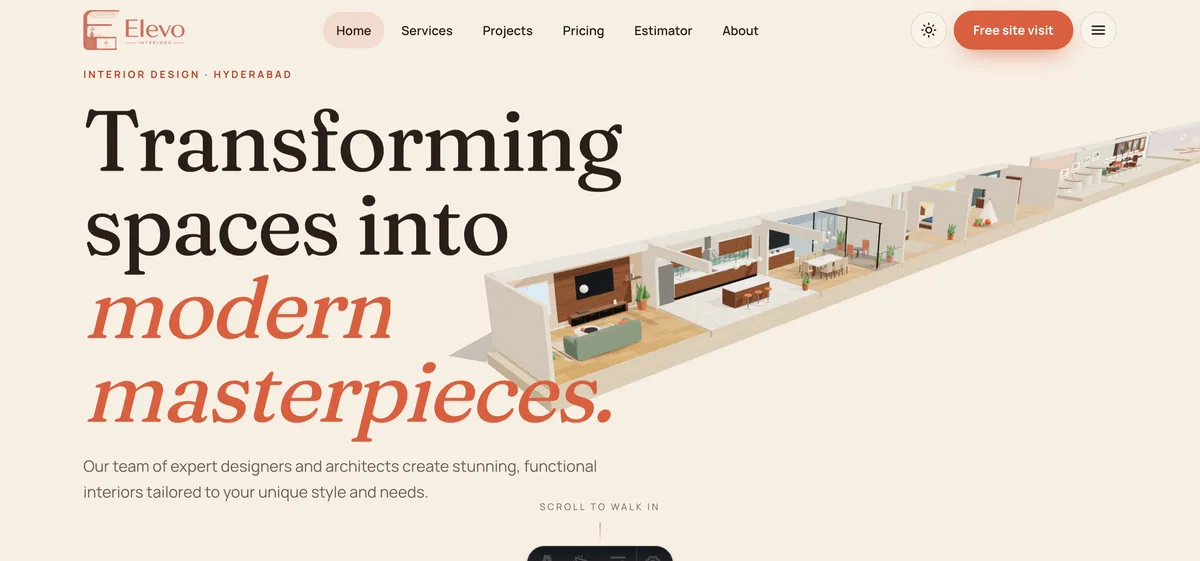
The Elevo Interiors demo has six area pages, for Banjara Hills, Gachibowli, Hitech City, Kokapet, Kondapur and Miyapur. The Kokapet page, for example, has its own title ("Interior Designers in Kokapet, Hyderabad | Elevo Interiors") and its own main heading, then lists the services and the process. The site also describes the business with address, phone and FAQ data in a form that machines can read, and has a tap-to-call link. That data tells search engines what the business is. It does not promise any position.
Navee Builders
The Navee Builders demo carries the city in its page title and lets visitors filter its property listings by locality and by type. Each property has its own page, so a buyer searching for a specific project in a specific area lands on a page about exactly that.
LiL ToT
The LiL ToT demo puts the locality in the title ("Play School & Child Care in Bahadurpally") and describes the school with address data, which suits a business parents look for close to home.
More examples are on the demo websites page.
What is a simple 30 day routine?
- Week 1, write the master copy. Name, address, phone, hours, one-line description of what you do.
- Week 1, fix your site. Make titles and headings clear, update the footer and contact page, add tap-to-call.
- Week 2, claim and complete your profile. Categories, services, photos, hours and website link.
- Week 2, correct other listings. Search for your business name and fix any mismatched details you find.
- Week 3, test speed and mobile layout. Check on a real phone and fix the slowest page first.
- Week 3, set up a review habit. Decide when and how you ask, and who replies.
- Week 4, add an area page or a useful service page. Only if you have real content to put on it.
After that, a monthly check of hours, photos and messages keeps the basics healthy.
Which mistakes waste the most effort?
- Several slightly different business names and numbers across the web.
- Copying one page for twenty areas with only the place name changed.
- Letting a former employee or agency keep sole control of the profile.
- Buying or writing reviews, or promising rewards for good ones.
- Ignoring a slow, heavy site and spending on promotion instead.
- Expecting results in a week. Local visibility builds slowly, depends on competition, and cannot be promised.
How do you get started?
If you want a site built with clear titles, fast pages, mobile layouts and room for local pages, read how Zenocta builds a website for your business and see what the starting price covers on the pricing page. Websites start from ₹8,888, and domain and hosting are billed separately. When you are ready, contact us for a free consultation and a fixed-price proposal.
Try it live
Open the real thing: demos run in a new tab with sample data, apps link to their own page.
 Live demoElevo Interiors demoA demo with six Hyderabad area pages, each with its own title and heading, plus machine-readable business data.
 Live demoNavee Builders demoA demo real-estate site whose listings filter by locality and each has its own page.
 Live demoLiL ToT demoA demo play school site with the locality in its page title and address data.
- ABrowse allAll demo websitesBrowse every working demo website.
- WBrowse allWebsite pricingWebsites from ₹8,888. Domain and hosting are billed separately.
- HBrowse allHyderabad website developmentZenocta's local page for businesses in Hyderabad.
Frequently asked questions
01Can any builder promise a first page position on Google?
No. Rankings depend on many signals, your content and your competition, and no honest builder can promise a position. A site can give you the foundation: clear titles, matching details, fast pages and a good mobile layout.
02What does NAP consistency mean?
NAP stands for name, address and phone. It means these details are written identically on your website, your business profile and every directory, so customers and search engines see one consistent business instead of several slightly different ones.
03Do I need a Google Business Profile if I have a website?
It is worth having if customers search for you nearby. The profile and the website do different jobs, and both should match. Claim it with a business login, keep it updated and check the platform's current guidance for its rules.
04Should I build a separate page for every area I serve?
Only for areas you genuinely serve, and only if each page has useful, specific content such as services, how visits work and a way to book. A few good area pages beat many near-identical ones with only the place name changed.
05Is it acceptable to ask customers for reviews?
Yes, asking real customers is normal. Share the link when the work is done, reply to every review politely, and never write, buy or reward reviews in a way that shapes what people say. Check the platform's current guidance.