In this guide
Most website projects that go wrong do not fail on design or code. They fail on a conversation that never happened: what the site is for, who it is for, who decides, and what "done" means. A one-page brief fixes that. It takes an hour to write, it lets any designer give you a sensible quote, and it protects you from the slow drift of "can we also add this?" This guide shows how to brief a website designer. It gives you the questions, a template you can copy, the questions a good builder will ask back, the red flags to watch for, and how a project runs at Zenocta from brief to fixed-price proposal.
Why does a written brief save time and money?
A designer who has not seen a brief has to guess, and guesses are expensive. They show a layout you do not like, you explain what you wanted, they redo it, and the project slips. A brief answers the big questions up front. It also gives both sides something to point to when a later request would change the scope. "That was not in the brief" is a calm sentence. "You never told me" is not.
A brief does not need to be long or polished. One page of honest answers beats ten pages of marketing language.
What goes in a one-page website brief?
Copy this table into a document and fill in the right-hand column. The examples are invented for a fictional dental clinic called Sample Dental and show the level of detail to aim for.
| Section | Question to answer | Example answer (fictional) |
|---|---|---|
| Goal | What is the one main thing the site must do? | Get new families to book a first check-up by phone or form |
| Audience | Who visits, and on what device? | Parents aged 28 to 45 within 5 km, mostly on phones in the evening |
| Pages | Which pages do you need on day one? | Home, Treatments, Meet the team, Fees, Contact, FAQ |
| Content owner | Who writes the text and supplies the photos, and by when? | The clinic manager, first drafts due in two weeks |
| Examples liked and why | Which sites do you like, and what exactly do you like? | Calm colours, large photos, one clear booking button on every screen |
| Examples disliked | What do you want to avoid? | Pop-ups, stock photos of models, long paragraphs |
| Budget range | What range are you comfortable with, and what is flexible? | A fixed amount for the site, with a separate small budget for later changes |
| Deadline | When must it be live, and why that date? | Before a new clinic opens next quarter |
| Who approves | Who gives the final yes, and who gives feedback? | The owner decides, two colleagues give comments in one batch |
| What you already have | Logo, colours, domain, email, current site, accounts | Logo and brand colours, an old site, a domain held by a previous designer |
| Must not change | Anything that has to stay the same? | Phone number, address, treatment names used on printed leaflets |
How do you write the goal and audience?
Start with the goal. If you write three goals, you have none, because a page that tries to do everything does nothing well. Pick the main action: call, book, enquire, buy, download or visit. Everything else is secondary.
- A good goal names an action a visitor takes, not a feeling you want them to have.
- Describe the visitor in a sentence: who they are, what they need, what worries them.
- Say where they are when they visit: phone, at work, on the move, in the evening.
- Note any languages, ages or access needs that shape the design.
- Say how you will know it worked. For example, "more enquiries through the form", not a number you cannot measure.
Which pages and content do you need?
List pages by purpose, not by habit. A page that answers a real question earns its place. Then decide who owns the content, because late content is the most common cause of delay in website projects.
- Name each page and give it one job.
- For each page, write who supplies the text, the images and any documents, and by what date.
- Gather photos of your real premises, work and team. Sample or stock images rarely build trust.
- Collect prices, opening hours, service descriptions, FAQ answers and policies.
- Decide who will update the site after launch, and how often.
- List anything legal or regulatory your sector requires on a site, and check the current rules with a qualified adviser.
Content is the real deadline
A designer can build a site in days if the text and images arrive on time. The same site can take months if each piece trickles in. Put content dates in the brief next to the launch date.
How do you share examples you like?
Examples are the quickest way to share taste, but only if you say what you like about them. "I like this site" tells a designer almost nothing. "I like how the booking button is always in view on a phone" tells them a lot.
- Pick three to five sites, including at least one outside your industry.
- For each, write one specific thing you like and one thing you would not copy.
- Pick examples for layout, tone, motion and photography separately if they differ.
- Say how much motion you want. A page that scrolls through a 3D scene is a very different project from a simple, quick, text-and-photo site.
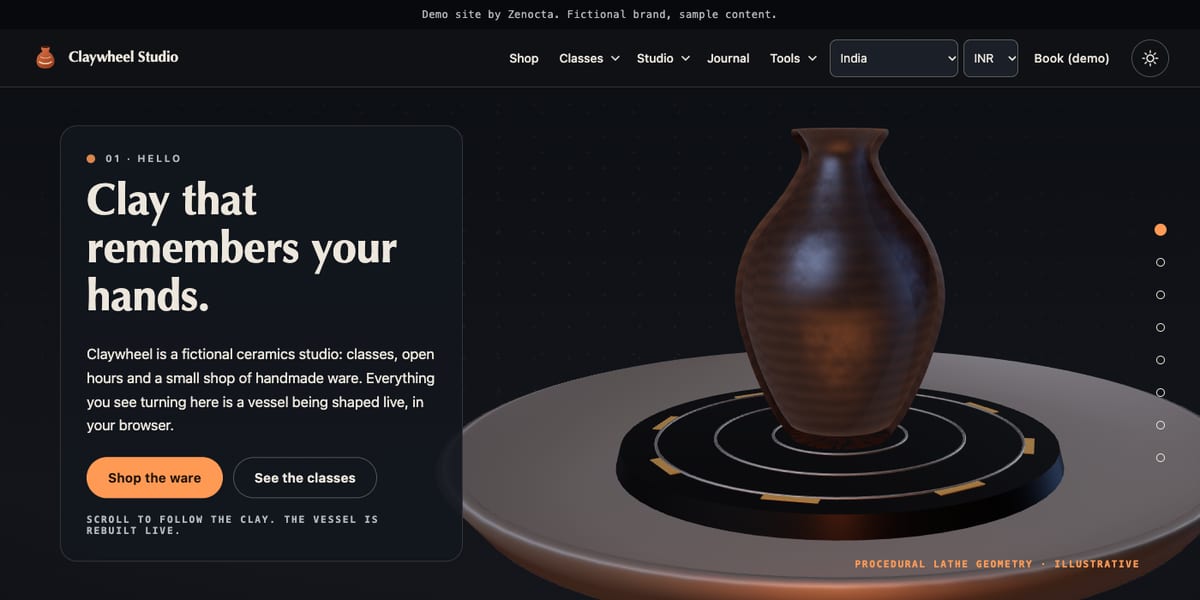
Zenocta's demo websites are a handy shortlist to start from, because each is a working site you can scroll on your own phone. Here is how a brief might use three of them as references. These are illustrations of how to talk about examples, not claims about any real business.
- Oruvale Studio: "I like how packages are compared in a single table, and how the process is shown in four short steps."
- Claywheel Studio: "I like the shop filter and the cost estimator. I do not need a 3D wheel, but I want the pieces shown from more than one angle."
- Fernwick Commons: "I like how each programme has its own page and how stories are told in plain words."
How should you talk about budget, deadline and approvals?
Many people avoid sharing a budget in case the builder inflates the quote. In practice a range helps both sides, because it shows which approach is realistic. If you cannot give a number, say what is flexible and what is fixed.
- Give a range, not only a ceiling, and say whether it covers extras such as photos, copywriting and training.
- Ask what is billed separately, for example the domain name and hosting, and note them as running costs.
- Know what moves the price: the number of pages, the features and integrations, and the timeline.
- Explain why the deadline matters. A fixed event date is different from "the sooner the better".
- Name a single approver, and agree how feedback is gathered, ideally in one consolidated round rather than five separate emails.
- Agree how many revision rounds are expected, and what counts as a new request.
What will a good builder ask you?
A designer who asks nothing is guessing. A good one asks questions like these, and your brief should already answer most of them.
- Who are your customers, and what do they ask before they buy?
- What is the single most important action on the site?
- Which devices and browsers do your visitors use?
- What do you already have: a logo, text, photos, a domain, an old site?
- Who will supply content, and who will keep it updated?
- What tools must the site connect to, such as a booking system or email service?
- Do you need the site to work in more than one language or currency?
- When must it launch, and what happens if it launches late?
Which red flags should make you pause?
- A quote with no questions asked and no written scope.
- A builder who registers your domain or hosting in their own name.
- No mention of what is excluded or billed separately.
- Promised search rankings or promised traffic. Nobody can honestly offer these.
- A price that changes whenever you ask for something small, with no written scope to refer to.
- No timeline, or a timeline with no dates for your own tasks.
- No access for you to your own accounts, files and content.
- Pressure to decide before you have seen a written proposal.
How does Zenocta go from brief to proposal?
Your brief does not have to be perfect before you contact us. Bring what you have and we fill in the rest in a conversation. The process on the how we work page runs like this.
- Free consultation. You tell us what the business needs. We ask about your users and devices, your deadline and the tools you already use.
- Scoped, fixed-price proposal. Within 24 hours you receive the scope, the timeline and one price in writing. Websites start from ₹8,888, and the final price depends on pages, features and integrations. Domain and hosting are billed separately and stay in your name.
- You approve first. No work begins until you approve the proposal, and the scope stays what you approved.
- Design and prototype. You see screens and flows early, while changes are still cheap.
- Build and test. Short build cycles, with progress updates, tested on real devices.
- Launch and improve. We go live with you and support the launch, then keep improving from real use.
A focused site can be live in as little as seven days. Larger sites take longer, and the proposal states the timeline before you approve anything. From you, we need accurate requirements, timely feedback, the access details the build requires and one named point of contact. Your brief is the quickest way to supply the first of those.
What should you do next?
Copy the template, fill it in for your business and read it aloud to a colleague. If they cannot tell what the site is for after two minutes, tighten the goal. Then see what Zenocta's website pricing covers, read about how we build websites, and send us your brief. For a short reminder of why the effort pays off, read why every business needs a modern website, and if you are weighing a full site against one page, see corporate website versus landing page.
Try it live
Open the real thing: demos run in a new tab with sample data, apps link to their own page.
 Live demoOruvale Studio demoA demo photography site to point to when you describe packages and a clear process.
 Live demoClaywheel Studio demoA demo ceramics site with a shop filter, classes and a cost estimator to use as a reference.
- ABrowse allAll demo websitesBrowse every working demo website as a shortlist of references.
- WBrowse allWebsite pricingWebsites from ₹8,888. Domain and hosting are billed separately.
- HBrowse allHow we workThe five steps from free consultation to launch.
- SBrowse allSend us your briefShare what you have and get a scoped, fixed-price proposal.
Frequently asked questions
01How long should a website brief be?
One page is enough. A short, honest brief covering goal, audience, pages, content owner, examples, budget range, deadline and approver is more useful than a long document, and it gives any builder what they need to quote.
02Should I tell a designer my budget?
Yes, a range helps both sides see what is realistic, and a good builder will not simply spend it all. If you cannot give a number, say what is flexible. Also ask what is billed separately, such as domain and hosting.
03What if I do not know what pages I need?
Start from your visitors' questions and list one page per real question, such as services, prices, about and contact. A good builder will help you refine the list in a consultation, and you can add pages later.
04Who should approve the design?
Name one person who gives the final yes, and agree how others give feedback, ideally gathered into one round of comments. Many approvers sending separate emails is a common cause of delay and extra revisions.
05Do I need to bring a finished brief to Zenocta?
No. Bring what you have and we fill in the gaps during the free consultation, where we ask about your users, devices, deadline and tools. You then get a scoped, fixed-price proposal within 24 hours.