Zenocta AI Team
Artificial Intelligence

9 min read
Introduction
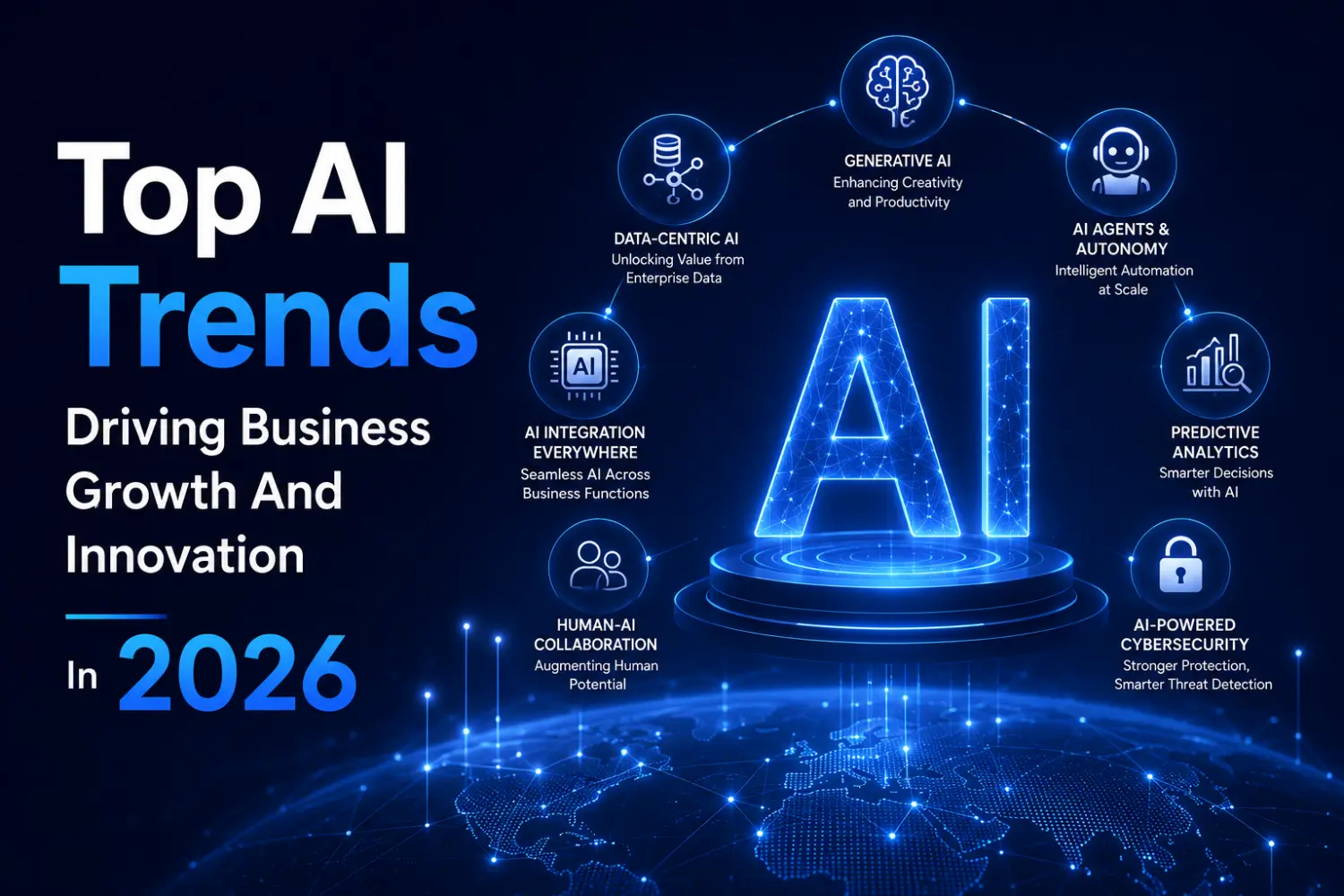
Every year brings a fresh wave of “AI will change everything” predictions, and most of them quietly disappear by the following year. 2026 is different mainly in degree, not kind: the AI capabilities that were experimental eighteen months ago have settled into dependable, boring infrastructure that ordinary software now runs on. That shift from novelty to infrastructure is itself the most important trend, and it changes how business leaders should think about AI planning.
This article focuses on the trends that actually affect day-to-day business operations and decision-making, rather than research-lab developments that are years away from practical use. If you run or advise a business, these are the shifts worth tracking closely.
The Problem
The challenge for most business leaders is not a lack of AI options — it is an overwhelming number of them, most wrapped in marketing language that makes it hard to tell what is genuinely useful from what is repackaged hype. Without a clear framework for evaluating trends, businesses either adopt too cautiously and fall behind competitors who are quietly automating routine work, or adopt too eagerly and waste budget on tools that don’t fit how the business actually operates.
This is made harder by the fact that AI vendors have strong incentives to describe every new release as transformative, regardless of how narrow or incremental the actual improvement is. A business leader without a technical background is left trying to separate substance from marketing on their own, often under time pressure, which leads to decisions driven more by whichever pitch was most persuasive than by which trend actually fits the business.
The businesses that navigate this well tend to rely on a trusted technical advisor or development partner to translate vendor claims into plain terms, rather than trying to evaluate every pitch alone. This doesn’t mean outsourcing the decision entirely — it means having someone in the room who can ask the right skeptical questions before budget is committed.
Understanding the Shift: From Standalone Tools to Embedded Capability
The clearest pattern shaping 2026 is that AI is disappearing as a distinct product category and reappearing as a feature inside software businesses already use. A few years ago, adopting AI often meant subscribing to a new, separate tool. Increasingly, it means the accounting software you already use quietly gains anomaly detection, or the CRM you already pay for starts drafting follow-up emails on its own. This matters because it lowers the adoption barrier significantly — there is no new tool to learn, just new capability inside a familiar one.
This embedding trend also changes how businesses should budget for AI. Rather than a separate line item for “AI tools,” the cost increasingly shows up as a feature tier within software subscriptions the business already pays for. Business leaders reviewing software costs should specifically check whether an upgrade to a higher tier of an existing tool would deliver more value than adding a new, separate AI subscription.
Agentic Workflows
“Agentic” AI refers to systems that can carry out multi-step tasks with some autonomy — not just answering a single question, but completing a small workflow: researching a topic, drafting a document, checking it against a set of rules, and flagging anything uncertain for human review. For businesses, this is meaningfully different from earlier chatbot-style AI because it can handle tasks with several steps, not just single requests.
The practical caveat with agentic workflows is that they work best in domains with well-defined rules and clear success criteria — processing a standard form, checking a document against a compliance checklist, compiling a weekly report from known data sources. They work far less reliably in ambiguous, judgment-heavy domains, which is exactly why the businesses seeing success with agentic AI tend to apply it narrowly rather than handing over an entire open-ended job.
AI-Assisted Decision Support Over Full Automation
Despite the automation narrative, the more durable trend in serious business deployments is AI as a decision-support layer rather than a full replacement for human judgment — presenting options, flagging risks, and summarizing information, with a person making the final call. This is partly a trust issue and partly a practical one: most business decisions have context that isn’t fully captured in the data a system sees, so pairing AI’s speed with human judgment tends to outperform either alone.
Multimodal AI in Everyday Workflows
AI systems that can work across text, images, and audio together, rather than being confined to one format, are moving from novelty to genuinely useful business tool. A retail business can now photograph damaged inventory and get an automatic condition assessment; a field technician can describe a fault verbally and get a relevant troubleshooting checklist. The practical value here isn’t the technical impressiveness — it’s that these tools fit naturally into how people already communicate, rather than forcing them to translate their work into a rigid text prompt.
Examples
Customer Support
Support teams are increasingly using AI not to replace agents but to prepare them — surfacing a customer’s order history, suggesting a response, and letting the agent edit and send rather than type from scratch. This trims average handling time without removing the human judgment that keeps difficult conversations from going wrong.
Financial Operations
Finance teams are adopting AI-assisted anomaly detection in expense reports and invoicing — not to auto-approve payments, but to flag the small percentage of transactions that look unusual for a human to review, instead of requiring someone to manually scan every line.
This same pattern is showing up in cash flow forecasting, where AI-assisted models combine outstanding invoices, historical payment timing, and seasonal patterns to give finance teams a more realistic projection than a simple spreadsheet formula — useful for a business deciding whether it can afford to make a hire or place a large inventory order this quarter.
Marketing and Content Operations
Marketing teams increasingly use AI to produce first drafts of campaign copy, social content, and product descriptions at a pace that would be impossible manually, while keeping a human editor in the loop for brand voice and accuracy — a pattern that has proven far more durable than fully unattended AI content generation.
The businesses getting the most consistent results from AI-generated marketing content are the ones that treat it as a drafting tool bound by a clear brand voice guide, rather than letting the AI define the voice on its own. Without that guardrail, content tends to drift toward a generic, forgettable tone that undermines the brand differentiation marketing is supposed to build.
Operations and Inventory Planning
Operations teams are using AI-assisted forecasting to plan inventory and staffing levels based on historical patterns and seasonal trends, catching demand shifts earlier than a manual monthly review would. This doesn’t eliminate the planner’s role — it gives them a stronger starting estimate to adjust based on context the system doesn’t have, like an upcoming local event or a known supplier delay.
Business Benefits
Businesses that adopt these trends thoughtfully tend to see benefits in three areas: speed (routine tasks complete faster because a first draft or first pass is already done), consistency (the same rules get applied the same way every time, reducing the variability that comes from different staff handling similar tasks differently), and capacity (existing teams can absorb more volume — more customer conversations, more transactions, more content — without proportional headcount growth).
These benefits compound when multiple workflows are automated together rather than in isolation. A support team using AI-assisted drafting alongside an operations team using AI-assisted forecasting doesn’t just get two separate improvements — the business as a whole becomes more responsive, because the same underlying data and tooling investment pays off across more of the organization.
There is also a talent-retention angle that gets less attention: removing repetitive, low-judgment work from a role tends to make that role more engaging, which can meaningfully improve retention on teams that previously spent large portions of their day on rote tasks.
A less obvious but important benefit is better institutional memory. When AI tools log and summarize decisions consistently, businesses retain more usable knowledge about why past choices were made, which matters enormously when a key employee leaves and takes years of undocumented context with them. Embedded AI tools that summarize decisions as they happen quietly reduce this kind of knowledge loss.
Best Practices
Separate the Infrastructure Trend From the Feature Trend
When evaluating a new AI trend, ask whether it’s describing a genuine infrastructure shift (like AI becoming embedded in ordinary software) or a specific feature you might or might not need. The former is worth tracking broadly; the latter is worth evaluating only against a specific problem you actually have.
A simple test: if a vendor’s pitch would sound equally compelling to almost any business regardless of industry or size, it’s probably describing a broad infrastructure trend worth being generally aware of. If the pitch is specific to a workflow your business actually has, it’s a feature decision worth evaluating on its own merits against the cost and effort of adoption.
Pilot Before Committing
Rather than committing to a trend company-wide, run a small, time-boxed pilot in one team or one workflow. This limits downside risk and produces real data about whether a trend is useful for your specific business rather than theoretically useful in general.
Keep a Human Reviewer in Any High-Stakes Workflow
Regardless of which trend you adopt, keep human review in place for anything with real financial, legal, or customer-relationship consequences. The businesses that run into trouble with AI adoption are almost always the ones that removed human oversight too early, not the ones that were too cautious.
Assign Clear Ownership for Each AI Tool
Every AI tool in active use should have one person accountable for monitoring how it’s performing, not just the person who set it up initially. Tools that nobody actively owns tend to drift — quietly producing lower-quality output over time as business conditions change — without anyone noticing until a customer or a number on a report flags the problem.
Future Trends
Looking beyond 2026, expect AI capability to keep consolidating into fewer, more integrated platforms rather than proliferating into dozens of point solutions — businesses will likely manage AI features through the core systems they already use (CRM, accounting, communication tools) rather than a growing stack of separate AI subscriptions. Expect also a growing emphasis on transparency and explainability, as businesses and regulators alike push for AI systems that can show their reasoning rather than operate as a black box.
Industry-specific AI, tuned for the particular data patterns and compliance needs of a sector like healthcare, finance, or manufacturing, is also likely to mature significantly, moving away from one-size-fits-all general AI tools toward options built around a specific industry’s actual workflows. Businesses evaluating AI trends should increasingly ask not just “is this AI good” but “is this AI built with my industry’s specific constraints in mind.”
Conclusion
The AI trends worth a business leader’s attention in 2026 are less about flashy new capabilities and more about how deeply AI is settling into the software businesses already run on. The winning approach isn’t chasing every new development — it’s tracking the handful of trends that genuinely change how work gets done, piloting them carefully, and keeping human judgment in the loop where it matters most. A business that does this consistently will end the year with a handful of dependable, well-integrated tools rather than a graveyard of abandoned pilots.
Frequently asked questions
It depends on the task. For well-defined, multi-step workflows with clear rules, agentic AI is increasingly reliable. For open-ended, high-stakes decisions, human oversight is still strongly recommended.
Insights & Blog
Latest articles & industry insights

Related case studies

Hostel Management
PropTech
Livevo

Fashion Tech
Marketplace
Lace

Inventory & Billing
Small Business
Instobill
Curious what we can build for you?