Zenocta Editorial Team
Editorial Team

9 min read
Introduction
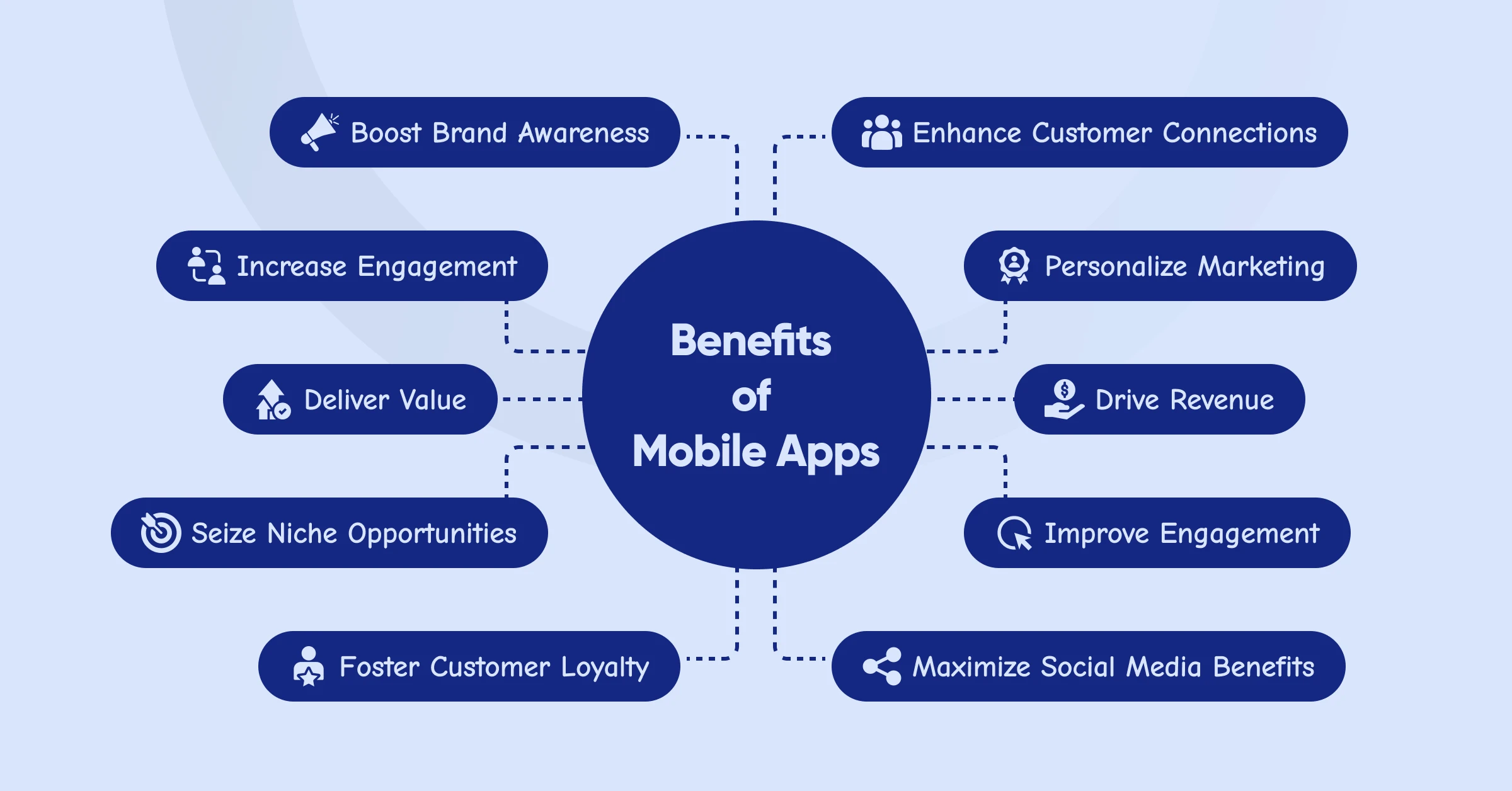
A decade ago, a mobile app was something mostly large brands invested in, largely as a marketing showcase. That’s changed. Mobile apps today are as much operational tools as they are customer-facing products — used for everything from managing field staff and tracking inventory to giving customers a faster, more direct way to interact with a business than a website ever could. This article looks at the concrete benefits a mobile app can bring to a business, and, just as importantly, how to think about whether it’s the right investment for yours right now.
The Problem
Many businesses either avoid building a mobile app because they assume it’s expensive and complex, or they build one for the wrong reasons — because a competitor has one, or because it seems like the modern thing to do — without a clear picture of what problem the app is actually meant to solve. Both mistakes are costly. The first leaves real efficiency and customer-engagement opportunities on the table. The second results in an app that gets built, launched, and then quietly ignored by both the business and its users because it was never designed around a genuine need.
The cost assumption in particular deserves a closer look, because it’s often based on outdated pricing from a different era of app development. Cross-platform frameworks and faster, more mature tooling have brought the cost of a well-scoped first version down considerably compared to a decade ago, when a native app on each platform meant essentially funding two separate engineering projects. A business that ruled out an app years ago based on that older cost structure may be surprised at what a focused, well-planned first version actually requires today.
Explanation
Direct, Frictionless Access to Customers
A mobile app sits on a customer’s home screen, which gives a business a level of direct access that a website, dependent on someone remembering a URL or finding you through search, simply can’t match. Push notifications, saved preferences, and faster repeat interactions all reduce the friction between a customer wanting something and actually getting it, which tends to translate directly into more frequent engagement.
Operational Efficiency Behind the Scenes
Not every valuable mobile app is customer-facing. Internal apps for field staff, delivery drivers, or store managers can replace paper forms, phone-call coordination, and manual reporting with structured, real-time data entry. This is often where the fastest and most measurable return shows up, because it removes repetitive manual work rather than adding a new customer-facing feature that takes time to gain adoption.
Building Customer Trust and Brand Presence
There’s also a quieter, harder-to-measure benefit: a well-built app signals a certain level of seriousness and permanence about a business. Customers tend to associate a polished, reliable app with a business that has its operations in order more broadly, in the same way a clean, professional storefront builds a certain baseline of trust before a customer has interacted with staff at all. That perception compounds over time, particularly in categories where trust is a meaningful part of the purchase decision, such as services involving payments, personal data, or recurring commitments.
Reducing Dependence on Third-Party Platforms
Many businesses today reach customers primarily through third-party channels — a marketplace listing, a social media page, an aggregator app — where the platform owner controls the relationship, the algorithm, and often the fees. A business’s own mobile app is one of the few channels where the relationship with a customer is owned outright, rather than rented from a platform that can change its rules, its pricing, or its visibility algorithm without notice. That’s not a reason to abandon third-party channels entirely, but it’s a strong argument for building a direct channel alongside them rather than depending on them exclusively.
Examples
A Retail Business Improving Loyalty
A retail business that launches a simple app with order history, saved preferences, and occasional relevant notifications gives customers a reason to return directly rather than searching generically online, where a competitor is one tap away. Over time, that direct channel becomes more valuable than any single marketing campaign.
A Field Service Business Cutting Admin Time
A field service business, such as a maintenance or repair company, that gives technicians a mobile app for job assignments, status updates, and digital sign-off can eliminate hours of daily phone coordination and paperwork, freeing office staff to focus on scheduling and customer service instead of manual reconciliation.
The same pattern shows up across other field-based trades — pest control, appliance repair, home cleaning services — wherever work happens away from a central office and coordination has traditionally relied on phone calls between dispatchers and workers on the move. Replacing that coordination with a shared, real-time view of jobs, locations, and status doesn’t just save time; it reduces the errors that come from information being relayed verbally through multiple people before it reaches the person who actually needs it.
A Healthcare Clinic Simplifying Bookings
A small healthcare clinic that replaces phone-only appointment booking with an app offering visible slot availability, automated reminders, and basic pre-visit forms tends to see fewer no-shows and less time spent by front-desk staff on scheduling calls. Patients get a faster way to book and reschedule; the clinic gets a calendar that stays more reliably filled without someone manually chasing confirmations.
This kind of app also tends to surface a secondary benefit that’s easy to miss upfront: a digital record of appointment history and basic patient preferences that used to live only in a receptionist’s memory or a paper file. Over time, that structured history makes it easier to spot patterns, follow up appropriately, and hand off scheduling duties between staff without losing context that used to depend on one specific person being available.
Business Benefits
Beyond the specific use case, mobile apps tend to deliver a few consistent advantages: better data. Every interaction inside an app, from what customers browse to how staff complete tasks, generates data that can inform decisions in a way that phone calls and paper forms never could. They also improve consistency, since a well-designed app enforces a process the same way every time, unlike a manual workflow that varies by whoever happens to be handling it that day.
There’s also a competitive dimension worth naming honestly: in many categories, customers have started to expect a mobile option, and a business without one can look dated by comparison, even if the underlying service is excellent.
A less obvious benefit shows up as a business grows: a mobile app scales in a way manual processes don’t. Handling twice as many customers or field staff through phone calls and spreadsheets usually means hiring more people just to keep up with coordination. A well-built app absorbs that growth largely as-is, since the same booking flow, the same job-assignment screen, and the same reporting dashboard work whether ten people are using them or ten thousand, which changes the economics of scaling a service business considerably.
Best Practices
Start With the Problem, Not the App
Identify a specific, real problem — slow order tracking, manual scheduling, weak repeat engagement — before deciding an app is the solution, so the product has a clear reason to exist from day one. Writing that problem down in one or two sentences before any design work begins is a useful discipline: if it’s hard to state clearly, that’s usually a sign the app idea needs more thinking before it needs a developer.
Keep the First Version Focused
Resist the urge to launch with every possible feature. A focused first version that does one or two things well is easier to build, test, and get real user feedback on than a sprawling app trying to do everything at once. Extra features can always be added once real usage data shows they’re actually needed, but a bloated first release is much harder to correct after launch than a lean one is to expand.
Plan for Both Platforms From the Start
Building with a cross-platform framework like Flutter means reaching both Android and iOS users from a single, well-maintained codebase, rather than choosing one platform and alienating the other. This matters even more for businesses serving a broad consumer base, where assuming everyone uses the same phone operating system can quietly exclude a meaningful share of potential customers.
Measure Actual Usage After Launch
Track real usage patterns after launch, not just download numbers, to understand whether the app is genuinely solving the problem it was built for, and to guide what gets built next. Download counts alone say almost nothing about whether an app is delivering value; what people actually do once they open it is the far more useful signal, and it’s worth reviewing that data on a regular cadence rather than only when something feels wrong.
Design for Low-Bandwidth and Offline Use
Connectivity is inconsistent outside major urban areas, and an app that fails outright the moment a signal drops feels unreliable regardless of how good the underlying feature is. Caching essential data locally and queuing actions to sync once a connection returns keeps the app usable in the situations where customers or field staff need it most, rather than only when conditions are ideal.
Future Trends
Mobile apps are increasingly expected to work well offline or on unreliable connections, particularly for field-based and service industry use cases, which is pushing more thoughtful local-data and sync design. AI-assisted features, like smart search, personalized recommendations, or automated data entry, are becoming standard expectations rather than premium additions. And the line between a business’s mobile app and website is blurring, with more businesses expecting both to share the same backend and data, giving customers and staff a consistent experience regardless of which they use.
Expect the bar for a “good enough” first version to keep rising as users become more selective about which apps they keep installed. That doesn’t mean every business needs a more complex app — it means the fundamentals discussed here, fast onboarding, reliable performance under weak connectivity, and a clear reason to open the app more than once, will matter even more than they already do, rather than being offset by flashier features alone.
Conclusion
A mobile app isn’t automatically valuable just because it exists — its value comes from solving a real, specific problem for customers or for the business itself. When that problem is clearly identified and the app is built with real usage in mind, the returns show up in ways that are hard to replicate through other channels: closer customer relationships, cleaner operational data, and processes that run consistently without depending on any one person to hold them together.
The businesses that get the most out of a mobile app tend to be the ones that treat it as an ongoing product rather than a one-time project. A first release that solves one real problem well, followed by iteration based on how people actually use it, consistently outperforms an ambitious launch that tries to anticipate every future need up front. Starting narrow and expanding deliberately, rather than starting broad and hoping it lands, is the pattern worth following regardless of industry or app category.
Frequently asked questions
Not necessarily. A mobile app makes sense when there’s a clear, recurring problem it can solve — frequent customer interaction, field operations, or manual processes — rather than as a default addition for every business.
Insights & Blog
Latest articles & industry insights
UPDATE
Jul 3, 2026
GST Billing App for Small Business: Fix Invoicing Errors
Still calculating GST by hand or wrestling with spreadsheets every billing cycle? Here's why manual invoicing breaks down and what actually fixes it.

Zenocta Engineering Team
Product Engineering
UPDATE
Jul 4, 2026

Best Offline Video Player App for Android Without Ads
Buffering, missing subtitles, intrusive ads, and apps that demand internet just to play a file already on your phone — here's why, and what actually fixes it.
Zenocta Engineering Team
Product Engineering
UPDATE
Jul 5, 2026

Attendance Management Software for Small Business Teams
Late check-ins, payroll disputes, and messy spreadsheets - here's why attendance tracking fails for growing teams and what actually fixes it.
Zenocta Engineering Team
Product Engineering
Related case studies

Hostel Management
PropTech
Livevo

Fashion Tech
Marketplace
Lace
Inventory & Billing
Small Business
Instobill
Curious what we can build for you?